Arnie’s Army Battles Prostate Cancer

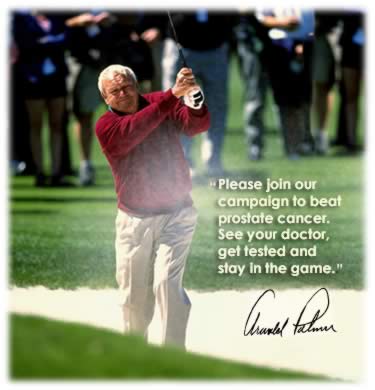
Help Arnold Palmer and his army battle prostate cancer by scheduling a par-3 at your local course.

I’m quoting directly from Larry on this one.

Arnie’s Army Battles Prostate Cancer is a great cause and you can help! All you have to do is ask your local club pro to schedule a Par-3 shootout. All funds raised go to the Prostate Cancer Foundation. Prostate cancer is the most commonly diagnosed non-skin cancer in America. Every 15 minutes a man dies from prostate cancer in the US.

prostate_cancer.jpg

Call for more info: 1.866.586.5585 or check out www.ArniesArmyBattles.com.

Titleist Pro V1

Twelve of the top fifteen finishers at the WGC-Amex play Titleist. Do you?

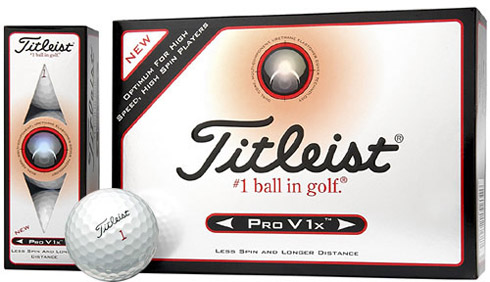
Titleist has long been the number one ball on tour. At one point, a Titleist had one over 40 consecutive US Opens. Tiger Woods ended that streak, and with the likes of Woods, Duval, Mickelson, and a few others playing balls from Nike or Callaway, Titleist finds itself in an unusual position.

prov1x_box.jpg

Vijay Singh and Ernie Els both play Titleist, and this week at the WGC-Amex, 12 of the top 15 finishers played the Titleist Pro V1 (x or no-x). Titleist equipment has always been for serious ballplayers, and the Pro V1 is no different.

At $56 MSRP (and about $40-45 retail), this ain’t no “32-pack for $19.99” kinda ball. I just found two-dozen Titleist DT-Spin (90 compression, three-piece, liquid center) in my closet. I wonder how they’ll play these days.

Just Putt

Get up and putt. Don’t line it up, don’t take a practice swing. Just putt!

Play a round of golf without lining up your putts. In fact, don’t do much at all: just get up and hit your putt.

“Just Putting” teaches you to observe the break and green conditions while you’re walking up to the green. It teaches you to feel the ground beneath your feet. Putting can’t become instinctual, but “just putting” will help it to become more natural.

Watch a bunch of decent 12-year olds putting. They don’t worry about line and speed. They get up and give the ball a whap. Avoid paralysis by analysis – just putt!

Eight Seconds

You’ve got eight seconds to repeat your swing or all of your feel is lost.

Short term muscle memory lasts about eight seconds. It can be said that “feel” lasts for eight seconds. Use this knowledge to improve your golf game.

When faced with a chip or a pitch, take your practice strokes nearby in similar conditions. Make some swings that feel good, then step up to the ball and repeat the swing within eight seconds. You’ll end up closer to the hole.

Shorten your preshot routine. Pick your target, stay relaxed, and then pull the trigger. Hanging over the ball for a thirty second preshot routine allows clutter – bad visualization, fear, etc. – to creep in. Pick a target, visualize the shot, take a practice stroke (or more, particularly on “feel” shots), take your stance, and hit it.

Eight seconds is probably longer than you think. You can still afford a simple preshot routine – a waggle, a regrip, a deep breath. Just don’t make like Sergio and regrip 37 times.

Segway as Caddy?

The Segway looks to make some green on the greens of your club with the “GT” model.

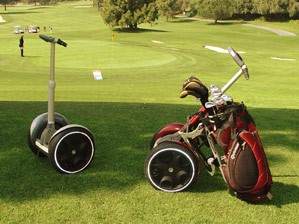
SegwayThe rumors are true: a golf-specific Segway is in the works. The “Segway GT” comes equipped to carry an ice chest, a scorecard, GPS equipment, and your clubs.

Segway officials showed off the GT at the PGA Fall Expo in the Las Vegas Convention Center. Several rounds of beta testing followed, and the company said that the product should be on the market by the end of the year (just in time for winter!). The suggested retail price is expected to be around or above $5,000, a number slightly higher than the Segway’s top speed of 12.5 MPH.

Segway HT America, the Houston-based distributor of Segway LLC, said the GT allows a foursome to play faster by transporting each golfer individually to his or her ball, and along cart paths, inclines and fairways. The company said the unit’s lightweight size and differential wheel is gentle on turf — allowing access to areas where standard golf cars generally are not allowed.

Funny, but we here at The Sand Trap .com thought that walking allowed you to do that too. And save $5,000+!

Scoring

There are two kinds of mentalities: shotmaking and scoring. Which type should you employ?

Scoring is important – it’s how we measure our success and progress. But score isn’t everything, and knowing when to apply a “scoring” mentality and when to apply a “shotmaking” mentality can bring tremendous improvement to your game. A stroke play mentality encourages risk-taking (i.e. “I need a birdie, so I’ll go at that flag tucked over the bunker”) while a shotmaking mentality encourages hitting solid shots (“I’ll start the ball at the middle of the green, and hit it solid. If I miss a bit right I’ll be tight.”)

Both mentalities allow you to score well, depending on the type of player you are. Play a few rounds in each style and try to determine where your balance lies.

Woods on Ryder Cup Selection

Tiger speaks out on Ryder Cup selection and a vice captain role.

Tiger Woods is now on record: he wants to be like Europe. At least when it comes to choosing the Ryder Cup team. Specifically, Woods wants a one year selection period instead of the current two. Woods said that “to get the true team that’s playing the best we’re going to have to go to a one-year period, like the Europeans do.”

Woods also expressed interest in a vice-captain’s role, saying:

I’d like to work with the captain on the pairings and team strategy and working on the whole concept of bringing the team together and doing what I can to make our team successful at the end of the week. I basically kind of do that now, but if I were a vice-captain it would have an official role.

It remains to be seen (and debated, of course) what exactly a title would offer if Woods is already fulfilling the role presently.

Beware the Injured Golfer

Who are we to question Tiger Woods’ word?

Tiger Woods shot -4 (68, T7) in the first round of the WGC AmEx Championship in Kilkenny, Ireland. He did so while battling a stinging pain between his shoulder blades. The pain was so great at times that Woods was visibly hurting, hunching over, and wincing in pain. Particularly on his first nine and on iron shots, one of the game’s greatest players had to bend over and “granny smithed” his ball from the hole after making putts.

There’s been some speculation that Woods was faking it or “whining.” Why, when Woods has played through pain before, would some be so quick to cry wolf when Tiger cries “owwwww?” Still others have bemoaned the “charter jet” lifestyle, saying “If Woods thinks charter jets are rough, he should try coach!” This misses the point. Woods has not whined. He’s played through pain in the past and today, played through even more to shoot, let’s not forget, a 68.

I can’t help but think that the negative reaction to his announcement that he may have to withdraw may have unnecessarily kept him in the tournament. Risking injury just to shut up a few people who really don’t deserve to be passing judgment may not be a sound move, but I’ve gained nothing but respect and admiration for a man who has shown that he can speak his mind honestly and plainly and play through pain. I, like many, hold Tiger to a high standard. I doubt he’d have it any other way. However, taking cheap shots at Tiger doesn’t make Woods look cheap. It only makes those taking the shots look cheap.

Besides, it’s not like he switched equipment companies after a record-setting year and a week before the Ryder Cup, right? 🙂

Grip it Good

Get a good grip before you even consider stepping onto the tee or you’ll be compensating all day long.

A golfer can swing incorrectly and get away with it by compensating. The more fundamental the flaw, the more exaggerated the compensation. Save yourself some trouble by getting the most basic (and easiest) fundamental correct: your grip.

One way to check your grip is as follows: While taking your grip, place a tee between your hands, positioned so that it’s pressed between the bottom of the fleshy pad beneath your right thumb and on top of your left thumb. Take the club back to the top of a normal backswing: the tee should still be in place.

If the tee has fallen out, your hands are separating during the swing. Separated hands let the club wiggle quite a bit at the top of the swing, changing both the angle of the clubface and the swing path.