
Grip, Grasp, and Ground

Check your grip, your gloves, and your spikes for wear. You’ll see – and feel – the results immediately.

Golfers rely on their equipment, and in no other sport is precision as important as in golf. An eight of an inch here or a quarter of an inch there, and you’re hitting three from the tee.

Why then do so many golfers neglect these three areas:

  • Grip
  • Glove
  • Spikes

These three things affect your grip and grasp of the club and the ground. If your grip is worn down, you won’t have a solid grasp of the club. The same holds true of gloves – and I’ve seen some ratty looking gloves. Worn down cleats? You can’t get a firm grasp of the only stationary object in the golf swing: the earth.

Check your grip, your gloves, and your spikes for wear. Replacing any of them is fairly inexpensive, and well worth the cost. You’ll see – and feel – the results immediately.
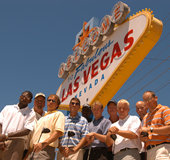
Blonde Ambition: Big Break II Finale

Kip Henley III survives a soap opera or two, a zany jackass, and 20 holes of golf to capture the Big Break II.

Big Break IIKip Henley III drew the ace and won the Big Break II in a 20-hole playoff against Don “Ninja Turtle” Donatello. Here’s the recap.

Kip, hitting first, split the first fairway with his 2I. Don struggled to get his nerves in check, but also split the fairway. Driving to his ball, Don says of Kip “Our friendship is over, and when we get finished our friendship will be back.” Each hit their approach to about 18 feet: Don left, Kip below. Kip leaves his putt short and Don pushes his putt low.

On the second hole, Kip misses wide right and Don “flails away”, hitting a toe-draw to the middle of the fairway. 250 from the hole, uphill, Don hits what he describes as an “absolutley perfect shot.” It “hit perfect” and then kicked into the bunker. HA! Kip pitches back into the fairway and then hits to 15 feet from 94 yards. Don complains about a rake mark and blasts the ball thin over the green. He takes a drop off the cartpath when he would have been better off playing it and finds himself in soft sand. He then “tried to hit a perfect shot” but fluffed it. Thinking “I can still make the shot” he chips to six feet. Don makes Kip putt, though he lies 5 and Kip lies three, and Kip putts it to a foot. Don then forces Kip to sink his one-foot putt. This is only the first of many “Don is a selfish jackass competitor” moments.

Kip goes to one up.

Rod Through the Spine

Stick a giant rod through your spine next time you’re on the range.

Golfers who get elaborate in their swings usually aren’t consistent. The true golf swing is a very simple affair when you’re playing well: you swing the club back, you swing the club through, and the ball goes where you’d like.

People often worry about their weight shift. A weight shift gets complex when the head starts moving about – that’s more of a slide than a shift, and it causes consistency problems.

The next time you’re on the range, try to keep your head absolutely still. I like to imagine a giant rod going down the back of my head, through my spine, and into the ground. I turn around this giant rod – my left shoulder working under, my right shoulder working around the top. I have no choice but to maintain both my spine angle and position through impact!

In reality, the best pros move their heads and their spines a little, but far more than the average amateur golfer thinks is necessary. Stick a giant rod through your spine next time and see how your consistency improves.

The Loooong Green Line

The back sleeve of the book describes Newport’s journey playing America’s mini tours as “wild,” but there’s nothing wild about it.

Fine Green LineI don’t admit to being much of a book reader: I tend to read books for information or for escape. I don’t read books to find meaning in my life. I read books that make me laugh, tell me a few stories, and while away the winter hours when my gal isn’t around.

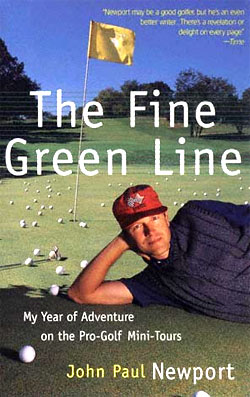
The Fine Green Line, by John Paul Newport, is not going to change your life. It won’t reveal any of your inner truths and it won’t improve your sex life. It won’t make you finally understand your father, your mother, your alter ego, or your fear of clowns. The Fine Green Line isn’t about money and it won’t tell you how to make any. In fact, it’ll cost you $12.95.

The book details John Paul Newport’s quest to experience life as a two-ish handicapper playing the professional golf mini tours (the image to the right tells you that). It leads JPN through a series of states, tournaments, bad shots, and lands him at the first stage of PGA Tour Q-School where he unceremoniously bombs, landing him in a Golf Week article about “bums of Q-School.”

How to Rake Sand Bunkers

Raking bunkers properly is a nice way of “paying it backwards,” and here’s how you do it.

Raking a bunker is one of the easiest things to do, yet many people have never taken the three minutes to learn the proper technique. Here it is, in easy-to-follow format.

Big Bunker
How would you like to rake this bunker?!?!

  1. Find the lowest spot around the edge of the bunker that’s near your ball. You will enter and exit here. Stepping in and out near a steep face causes erosion and pushes the sand off the face and into the bottom of the bunker. Plus, it’s easier to rake flat areas of sand.

Set Makeup

Today’s tip is simple: take a look at your set makeup and see where you might make some changes.

The Rules of Golf allow you to carry up to fourteen clubs. There’s no law that says the clubs must be comprised of a 1, 3, and 5-wood, 3I-SW, and a putter. First of all, that’s only thirteen clubs. Second of all: choose a set that best fits you!

In choosing a set, you want to consider a few things. First, you need a putter. You’re down to 13 clubs. Are you good? Consider going with four wedges. Just starting out? Consider going with the stock two or three. Not very strong off the tee? Why carry a driver or a 3I?

Consider alternative clubs. If you have trouble hitting a 3I, or want a club with more loft, look into one of the utility clubs now available. With players like Vijay Singh carrying high-lofted “woods” these days, that 9-wood in your bag can’t even take down your macho level!

We could get into much more depth than this (and we may in coming days), but today’s tip is simple: take a look at your set makeup and see where you might make some changes.

Host with the Most: Tiger On Target

Woods donated the $1.25 million he won to his foundation. Vijay Singh finished 11 shots behind.

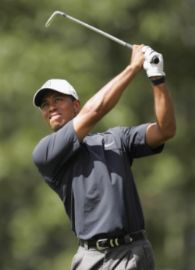
Tiger in ActionTiger Woods is the host with the most, and has captured victory in his own tournament, the Tiger Target World Challenge. Missing only two fairways and one green en-route to a closing 5-under 66, Woods capped off his year with his second win in a row. Woods’ play was marvelous, and he knew it, saying “Every shot I wanted to hit, I hit.”

Padraig Harringon shot a 31 on the front at Sherwood Country Club to get into contention, but faltered on the last three. He bogeyed 16, birdied 17, and then bogeyed 18 after an errant drive. He earned $750,000 for finishing second.

Colin Montgomery, starting the day with a two-stroke lead and having never won a stroke-play tournament in the US, bogeyed the first hole and shot 71 to finish at 13-under 271 with his playing partner, Jay Haas.

Grip Pressure

One tour player hits a fade by gripping the club harder with his top hand. What will you learn?

Today’s tip will be a short one on grip pressure. Here it is: experiment!

One tour player found that to hit a fade, he merely had to grip the club tighter in the pinkie and ring finger of his left hand. Another found that the looser his right hand held on to the club, the more solidly he struck the ball. Your grip pressure should never be so tight that the pressure or tension goes into your arms and shoulders – but you will want to grip the club firmly enough to counter nearly 100 pounds of force, too.

Left Armpit

Try sticking a glove in your left armpit – and keeping it there – throughout the swing.

The pros hit the ball unbelievably low. They “cover” the ball with their chest (and clubface) through impact. They do this by keeping the left arm against the body and moving their chest through impact: the arms “tag along” and the wrists snap at impact, resulting in a “pinch” and a low, boring trajectory with a lot of spin.

We’ve all seen Vijay Singh hitting balls with a glove tucked into his left armpit. He does this to help him keep his arm “attached” to his body. If his left arm moves away from his body, the glove falls out. Chris DiMarco, as part of his pre-shot routine, folds his sleeve into his left armpit to force the same swing thought (his is course legal; Vijay’s is not).

If you’re having trouble keeping that arm attached, try sticking a glove in your left armpit – and keeping it there – throughout the swing.