

Play in the Now

Play in the now means not worrying about your score, the next hole, or a birdie putt while you’re on the tee.

BrainThe next ten “Tip of the Day”s are being taken from an article by Dr. Bob Rotella for Golf Digest, titled “Inside the Golfer’s Mind.” We’re paraphrasing, changing the language a little, and condensing his typical three to four paragraphs into one or two. This is tip five of ten: play in the now.

Really, this tip is very much like some of the others available in this same series of articles. Dr. Bob needed ten tips, bydoggit, and he was gonna get ’em, even if meant repeating the same thing five or six times. What useful tidbits can we glean from this rehashing?

  1. Don’t let play dictate your attitude. Go with the flow when it’s going well, but control yourself when you’re playing poorly.
  2. “I came to the 16th thinking ‘this is a birdie hole'” is an example of getting ahead of yourself. Hit your tee shot first, then your approach, and then worry about making a putt.
  3. Hit it and find it. Repeat as necessary.
  4. Improving your mind game can instantly take 5-10 strokes off of your average score.
  5. Don’t keep a running tally of your score. It makes you think of things outside of the “now,” the “present,” and “the next shot.”

When you run out of holes, you run out of holes. Hit it and find it. When Dr. Bob runs out of ideas, well, he copies other ones, but that’s ok. Tomorrow’s tip is different. Kinda. Okay, barely.
Golf is Awesome

Golf is an awesome game.

If golf did not exist, and I were to cut a 4¼” hole in the ground, give you some metal sticks and a small ball, put you 400 yards from that hole, and tell you that a decent “player” of this new sport would expect to get the ball in the hole in about four strokes, you’d surely laugh.

Sometimes, I struggle to fathom “golf.” I play to less than a 9 handicap. I break 80 fairly regularly on a course sloped at 135 or so. In fact, I am disappointed if I don’t break 80. 80 strokes to bash a little ball with metal sticks over four miles, holing it 18 times along the way.

A long home run might travel 450 feet. That’s a 7-iron for many people, and good players expect to hit their “home run” 7-irons to within three to four bleacher seats of the hole. I stand in awe sometimes, not of my own ability, but of mankind’s. Of a beginner’s ability to get their first par, of Tom Kite’s ability to get up and down from nearly anywhere inside of 100 yards, and from Daly’s or Woods’ or Kuehne’s ability to blast a ball. 300+ yards. On the fly.

With a metal stick.

The Past is the Past

The past is the past: worry about the next shot. It’s the only one that matters.

BrainThe next ten “Tip of the Day”s are being taken from an article by Dr. Bob Rotella for Golf Digest, titled “Inside the Golfer’s Mind.” We’re paraphrasing, changing the language a little, and condensing his typical three to four paragraphs into one or two. This is tip four of ten: the past is the past.

The instant your club makes contact with the ball, the shot is in the past. You can’t change the physics of your ball flying through the air or your ball rolling on the green (not legally, anyway). The shot has already happened. The result you can’t affect. The next shot you can. Getting angry over a missed putt, a fat 7-iron, or a sprayed drive means that you’re not playing in the present and focusing on the next shot.

Remaining competitive does not mean getting angry with yourself – it means making up for mistakes with great shots. The next shots after your misses. You’ve probably made par from the junk before. Do it again. Worrying about the shot that put you into the junk won’t help get the ball in the hole. The past is the past: worry about the next shot. It’s the only one that matters.

Sorenstam Saves the (Skins) Day (1)

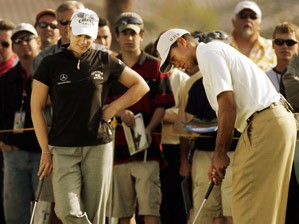
Newcomer Adam Scott won two quick skins to kick things off in the Skins Game, but neither he, Sorenstam, Tiger Woods nor Fred Couples could break through in the other seven holes. With all those Saturday skins still alive, a rich Sunday is on tap.

Tiger AnnikaAnnika Sorenstam is Tiger Woods’ new hero. After holing a short birdie putt on the ninth hole of the 2004 Skins game, Tiger expressed his admiration for Annika by giving her a (Golden?) bear hug.
It didn’t hurt that her birdie kept $250,000 in play in this, the twenty-second playing of the Skins game.

With Scott already in the hole for a birdie, Woods’ six-footer for bird lipped out, leaving the weight $250,000 squarely on sorenstam’s shoulders. “I should’ve made things a little bit easier for Annika on the last hole, but kind of blew that one,” said Woods, “but I had my chances today to get a couple skins and just couldn’t do it.”

Meet Small Goals

Set small goals – and meet them – consistently.

BrainThe next ten “Tip of the Day”s are being taken from an article by Dr. Bob Rotella for Golf Digest, titled “Inside the Golfer’s Mind.” We’re paraphrasing, changing the language a little, and condensing his typical three to four paragraphs into one or two. This is tip three of ten: meet small goals.

When I played baseball, and pitched, I would not throw to the glove. I wouldn’t throw towards the plate. I’d throw towards a stitch on the glove – the smallest thing I could see. When I play golf, I don’t try to “break 80” – I try to hit solid shots. I try to hit the ball in the right position. Golf is a game of small goals: hit the next shot well. Achieve the small goals often enough during a round and you’re more likely to achieve an overall goal without even thinking about it.

Them’s the Breaks

Golf is an unpredictable and sometimes unfair game. Them’s the breaks.

BrainThe next ten “Tip of the Day”s are being taken from an article by Dr. Bob Rotella for Golf Digest, titled “Inside the Golfer’s Mind.” We’re paraphrasing, changing the language a little, and condensing his typical three to four paragraphs into one or two. This is tip two of ten: them’s the breaks.

Golf is an unpredictable and sometimes unfair game: your opponent thins his approach, bounces it off a turtle swimming merrily in the water, and ends up three feet from the pin. Your drive, 30 yards past him, sits in a divot, hits the flagstick, and careens into the bunker. Them’s the breaks – learn to love ’em. After all, they’re a big part of the game you chose to play. (Golf, in case you were confused.)

Nobody perfects the game of golf. Sometimes a perfectly struck drive windsd up in a divot. Sometimes it’s the divot you took yesterday. And sometimes the same thing happens to your opponent. Golf is a game of breaks, and it’s the game you’re playing. Getting mad won’t help. Getting frustrated won’t help. Roll with it – there’s nothing you can do. Them’s the breaks.

Play to Win

“Playing to win” doesn’t mean trying to pull away from your opponent on the first six holes – it means putting yourself in a position to seal a victory with great play down the stretch.

BrainThe next ten “Tip of the Day”s are being taken from an article by Dr. Bob Rotella for Golf Digest, titled “Inside the Golfer’s Mind.” We’re paraphrasing, changing the language a little, and condensing his typical three to four paragraphs into one or two. This is tip one of ten: play to win.

Playing to win doesn’t mean playing recklessly – it means playing smart, controlled, and confident. As Phil Mickelson’s 59 yesterday taught us, you don’t need to be 300 yards down the middle of every fairway (he hit 5) to play well. You don’t need to be two feet from every pin. Some of a player’s best scores come when his ballstriking isn’t at its peak.

Playing to win means holing putts. It means keeping yourself in the game. Playing to win doesn’t mean trying to pull away from your opponent on the first six holes – it means putting yourself in a position to seal a victory with great play down the stretch.

On Architecture

Random quotes by some of the more famous golf course architects.

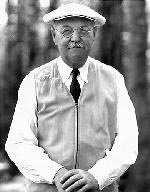
Donald RossAs beautiful as trees are, and as fond as you and I are of them, we still must not lose sight of the fact there is a limited place for them in golf. We must not allow our sentiments to crowd out the real intent of a golf course, that of providing fair playing conditions. If it in any way interferes with a properly played stroke, I think the tree is an unfair hazard and should not be allowed to stand. – Donald Ross, from “Golf Has Never Failed Me”
Every hole should be a demanding par and a comfortable bogey. – Robert Trent Jones, Jr.

Mickelson Fires 59, Wins Grand Slam of Golf

Phil Mickelson misses a six-footer for 58, taps in for 59, and wins the 2004 Grand Slam of Golf.

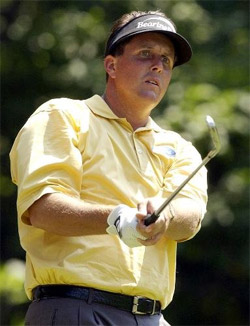
Phil Mickelson IronPhil Mickelson, Masters winner, has joined the ’59’ club and won the 2004 PGA Grand Slam of Golf. The event, which features each of the year’s major winners, was played over two rounds at Hawaii’s Poipu Bay Golf Course – no easy challenge at par 72, 7,081 yards.

Phil’s round features birdies at 2, 3, 4, 5, 7, 9, 12, 13, 14, 16, and 18 and an eagle at 6. He parred the other six holes. Phil had a six-footer for 58 on the last, but slid the putt just past the hole. He had a tap-in for the 59.

Members of the ultra-presigious “59 Club” now include the following

Al Geiberger           1977
Chip Beck              1991
David Duval            1999
Annika Sorenstam       2001
Phil Mickelson         2004

Phil ended up at -17. Vijay Singh finished second at -12, birdieing the last to secure that spot, while Retief Goosen finished at -11. Todd Hamilton finished with a 75 to end up at +1 for the tournament.

Is Phil’s switch to Callaway finally starting to pay off!!!

P.S. A day later, ESPN and The Golf Channel provide coverage.