Golf Punk

Golf Punk is a new magazine for the more “alternative” golfer.

There’s a new golf magazine out there, if you’re into that sort of thing: Golf Punk labels itself as an “alternative” golf magazine, with hot chicks, tattoos, and a bunch of other “in your face” type of coverage. Your grandfather’s Golf Digest this is not.

Golf Punk Bunker Babes

We just like the hot babes (that’s two separate links, folks). We don’t like the cost (£21 for Europe to £42 for the rest of the world).

When to Practice

When you practice is just as important as how you practice.

When are you more likely to hit the range: after a good round or after a bad one? Golfers are more likely to hit the range after a bad round than a good one, which begs the question: how do you ingrain a good swing if you only practice when you’re not swinging well?

Instead, reverse the two. Practice when you’re playing well. See a pro when you’re not.

If you’d like to find a PGA instructor, use the search engine at pga.com.

Any Wedge from the Sand

The long bunker shot is one of the toughest in golf, and attempting it with a sand wedge will likely leave you in a dreary position.

Lots of times, people get hung up in playing the sand wedge from the sand. If you’re bunkered 30 yards from the pin with a lot of green to work with, take your 9I or even an 8I, don’t worry about the club digging (it will), and make a good swing.

The long bunker shot is one of the toughest in golf, and attempting it with a sand wedge will likely leave you in a dreary position. Take a longer club, a shorter swing, accelerate through the sand, don’t worry about the follow through too much, and play quite a bit of roll.

Between Clubs? Land it on the Green.

When you’re faced with an in-between shot, choose the club that lands the ball on the green.

When you’re between your 7I and your 8I, what kind of shot do you play? A soft 7? Punch an 8? Here’s some practical advice: take the club that will land the ball on the green. If the pin is in the back, take the 8I. If the pin is in the front, take the 7I. Your “normal shot” will be on the green, leaving you with a putt at a birdie.

Putt on a Line

Most putting teachers, including Dave Pelz, recommend a “straight back, straight through” putting stroke. This tip helps you craft a simple line.

Most putting teachers, including Dave Pelz, recommend a “straight back, straight through” putting stroke. Grooving one is easier said than done: there’s no actual line against which you can judge your stroke!

Find yourself some twine or string and a pair of chopsticks. Break the chopsticks in two (so you have two little wooden stakes) and tie the string around the fat portion of each. Find a straight putt and push one stake into the ground behind the hole. Put the other on the straight line about six feet from the hole, keeping the string taut.

The rest is simple: place your ball under the string and both the line on which you want to hit the putt and a line that helps you judge “straight back, straight through” is there for you.

Tiger Battles, Haas Leads Tour Championship

After a forgettable first round, Tiger Woods roared back to life Friday with a bogey-free 64 at the Tour Championship, matching his best round of the year.

Tiger Tour ChampionshipTiger woods came roaring back today and Jay Haas not only held onto but extended his first-round lead in the PGA Tour’s season-ending Tour Championship at East Lake in Atlanta, GA.
A month shy of his 51st, Jay Haas followed up his first-round 3-under 67 with an even better 4-under 66 to take a two-shot lead over Stephen Ames. Haas is the oldest man to ever qualify for the Tour Championship. “Any time I lead is a great feeling at 20, 30, 40, 50, whatever it is,” said Haas. “It’s way too early to get too excited about it. But I haven’t done it with smoke and mirrors. I’ve played solid golf, and that gives me encouragement for the weekend.”

Play Catch

Practicing distance control doesn’t have to be boring: turn it into a fun game of “pitch” and catch.

Practicing distance control doesn’t have to be boring: turn it into a fun game of “pitch” and catch. Get your husband, your son, your wife, daughter, friend, nephew, aunt, or buddy to put on a glove and stand some distance from you. Hit ten shots, allowing your friend to move between shots. Count the number of times your friend can make a catch without moving more than one step in any direction.

Then switch and let your partner try to beat your score. Use any club in the bag and play a range of distances from 20 yards to 100 yards. You will want to win, and so you’ll quickly locate the distance with which your partner has the most difficulty, encouraging him to practice his weak spots (and he yours).

Finchem, Els Settle Misunderstanding

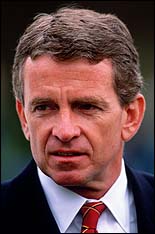
PGA Tour Commissioner Tim Finchem’s comments took some steam out of speculation about an imminent showdown with Ernie Els.

Tim FinehcemWe’ve previously written about Ernie Els and his battle with the PGA Tour here and here. Turns out it really wasn’t that big of a deal.

PGA Tour Commissioner Tim Finchem sees “no problem” with the amount of tournaments Ernie Els plays overseas. Said Finchem “he’s playing enough to satisfy his membership requirements on the PGA Tour.”

Finchem’s comments defused a bomb that was set to explode at this week’s Tour Championship. Els said last month that he planned to meet with Finchem at the tournament and was frustrated over having to play more tournaments to obtain overseas releases. “Don’t start putting a padlock around me because that’s not going to work,” Els said during the HSBC in England.

Geiberger Fined $20,000 for Slow Play

Brent Geiberger believes he was found guilty by association after the tour introduced a tough penalty structure to combat slow play.

Brent Geiberger is the first player to have been fined $20,000 for slow play. He was put on the clock ten times in one season. “I understand they’re trying to do something about slow play and trying to get a system that works,” Geiberger said. “But it’s not a system that shows you’re a slow player.”

Last year, the PGA Tour introduced a highly penal system to combat slow play. Some players feared that they would be guilty by association if they were consistently paired with slow players. According to PGA Tour rules, all players in a group are put on the clock if the group is out of position.