Regrip

You’ve only got one grip per club. Take care of it!

GripsTake care of your grips. They’re your only link to the club.
  • Change your grips out about once every year or two.
  • To keep your grips feeling tacky, spray them down every few rounds with Windex or similar cleaner, wipe dry.
  • During a round, wipe your grips prior to playing a shot.
  • Keep an eye on your grips for wear patterns that indicate problems in your swing.
  • Pay careful attention to the thickness of your grips – thinner grips promote more hand action, thicker ones less.

We recommends grips from Winn Grips or Golf Pride. Professionals can install grips for about $5/grip, grip cost included.

Putter Forward

Put the ball forward in your stance to hit the ball with a smoother roll.

Your putter is designed to get the ball rolling smoothly. You diminish its ability to do so if you play the ball back in your stance. To roll with topspin, putts should be struck – like your driver – with a slightly ascending trajectory. Put the ball just forward of center in your stance to ensure that this is happening.

There are times to play the ball back, too: when your ball is against the fringe or a cut of rough, for example. Hitting down on the ball introduces backspin, which causes putts to skid and slide offline and with less control.

Shoulder Alignment

An open stance is one thing. An open pair of shoulders is another.

It’s true that tour pros often align their feet left of the target. An open stance makes it easier to clear the hips, generating tremendous lower-body drive and power. Many amateurs take an open stance as well, but they typically do so not to obtain power, but to try to make the ball go left. Most amateurs slice.

Pros don’t slice with an open stance because their shoulders remain square. Oftentimes an amateur feels “closed” with square shoulders (particularly if their stance is open). Shoulders can also open up when you take that “one last look” down the fairway in your preshot routine.

Check your shoulder alignment in the mirror. For righties, you shouldn’t see your right shoulder at all – it should be behind (and slightly lower than) your left shoulder.

Chip Hip to Hip

A little flippy with the wrists when you chip? Try chipping from “hip to hip.”

Distance control is critical on chips. A sharp, descending blow that repeats itself chip after chip is preferable to a wristly “flippy chip” every time.

For crisp contact and good distance control, think of moving your arms from hip to hip. When you flip your wrists, your arms tend to remain near the center of your body. Keep your wrists quiet and move your entire arm – and the clubhead – through impact.

Light a Match in Bunkers

Light a match to light up your bunker play.

Gary Player is widely recognized as one of the best bunker players in the world. In his “Playing Lessons from the Pros” (on the Golf Channel), Player gives an interesting tip for playing out of the sand:

When you light a match, you don’t just slowly drag the match along the box. You flick it – fast – kkkkshhhhhhttttt! You do the same thing when you play out of the bunker. Don’t try to slide the club slowly through the sand – it won’t come out! Instead, flick it through the sand, accelerating rapidly. The ball will pop out with lots of spin.

There you have it. Light a match to light up your bunker play.

The Best $4 You’ll Ever Spend (on Your Golf Game)

Buy a swing weight donut and you won’t regret it.

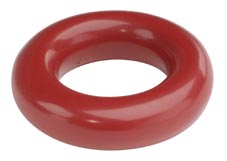
Swing Weight DonutLooking to boost your swing speed? Looking to quickly warm up before a round? Looking to hurl something hard at someone after they hole out from the fairway to win their press and your $20?

The swing weight donut is the best $4 you’ll ever spent. Swing weight donuts are small and fit easily in your bag or shoe. They’re easier to use as warmup devices than swinging two or three clubs at once. Donuts can serve as targets on chipping greens or your “office putting green.” Donuts can keep your towel from blowing away in a breeze. Use them on your putter to help ingrain a smooth stroke. They’re versatile, they’re lead, and they’re red!

Spend the $4. You won’t regret it.

Breezy Easy

When it’s breezy, swing easy

“When it’s breezy, swing easy.” You’ve heard this before, but what has made this one hold up for so long? Two reasons, really:

  1. Smooth swings increase the likelihood that solid contact will be made, creating a penetrating ball flight.
  2. If you make solid contact swinging hard, more backspin is created and the ball is likely to balloon up. Less spin = more penetrating ball flight.

Discipline yourself to take an extra club or two and to swing easy and you’ll have a lot more putts for birdie than your playing partners.

How’s Your Aim?

“Are you even aiming at the hole?” Well, are you?

Putting is difficult. It’s even more difficult when you have a problem aiming. Find out if you have a problem aiming by doing this simple drill.

Lay a metal tape measure on the ground. Tape a dime at one end, and then 20 feet away, a piece of masking tape exactly perpendicular to the tape measure (you may wish to use a t-square). You’ve created a perfectly straight putt with an alignment aid.

Remove the tape measure and set your putter on the perpendicular piece of masking tape. Cover the dime with a towel. Have a friend place golf balls on what you imagine is the line from your putter to the dime 6 feet, 12 feet, and 18 feet from you. Remain in your putting stance the whole time, instructing your friend to move balls left or right. Remove the towel and check your aim: are you left? Right? Dead on the line with each of the balls?

Aim, according to Dave Pelz, is the first fundamental of putting. Find out more about Dave Pelz at pelzgolf.com. If you’re really serious about your aiming, check out the LazrAimer. Only $459! (C’mon, you’re not that serious, are you?)

Head Down the Line

David Duval doesn’t do it. Annika Sorenstam doesn’t do it. Both have been or are the #1 golfers in the world.

David Duval doesn’t do it. Annika Sorenstam doesn’t do it. Both have been or are the #1 golfers in the world. What don’t they do? “Keep their head down.” Both Annika and David have a very pronounced head turn at impact, following the ball down the target line.

What began as a training tool for Annika was incorporated into her swing. She found that it eliminated her tendency to “hang back” and finish in the reverse C position. If you have trouble shifting your weight forward through the ball, try to swing like Annika: let your shoulders pull your head around as if you’re following the ball as it leaves your clubface. Finish with your weight forward and standing tall, watching the ball head straight.