
Tour Driving Distances

Tour driving distances may not be all that you expect…

Tour driving distances may not be all that you expect. We hear – and see – the occasional 300-yard bomb, but what’s the real deal? How far do pros hit the ball on most holes throughout the tournament? The holes on which they’re not being measured for driving distance (the pros know ahead of times which holes those are).

At the recent Tour Championship, The Sand Trap .com reader Ryan Dorn tracked the driving stats of seven of the PGA Tour’s best players. Chris DiMarco’s driving totals might clue you in to the actual distances that pros hit the ball.

Okay, the players know ahead of time which two hole count as the driving holes. Those holes they are gonna give it a little bit more because no one wants to be the short guy, but if you look at what realistically happens, it’s not what you hear on tv. Chris Dimarco is right around the middle of the pack on tour in terms of distance. Here’s every par 4 or 5 tee shot he hit this week. He “averages” around 285 yards (I can’t pull it up either), but he only hit 10 of 56 shots 285 or more.

Chris DiMarco Driving Distances, 2004 Tour Championship

Hole     Day 1    Day 2    Day 3    Day 4    Average
  1       269      238      274      272      263.25
  3       254      246      252      263      253.75
  4       281      310      274      278      285.75
  5       288      310      309      303      302.5
  7       240      251      255      245      247.75
  8       277      269      273      279      274.5
  9       295      291      303      301      297.5
 10       275      267      250      279      267.75
 12       262      273      276      276      271.75
 13       267      266      257      274      266
 14       253      277      270      274      268.5
 15       273      262      273      268      269
 16       242      280      260      289      267.75
 17       258      251      258      271      259.5

Keep this in mind the next time you’re on the tee! You don’t need to hit it 300 yards – and tour pros almost never do – to score well.
Chip over Pitch

Do you chip and run or pitch more frequently? Odds are you’ve got it backwards.

When you’re just off the green, do you chip or pitch? For too many people, the answer to that question is “pitch.” Pitching is great when you need to get over something – a bunker, water, a huge swale in a green – but when you’ve got green to work with, the chip is your shot.

A rolling ball is far more predictable than one flying through the air and landing hard on the green. Whether you use a sand wedge or a 7-iron, get the ball rolling quickly. To that, here are some simple guidelines for your short game:

  1. Putt when possible. This rolls the ball the entire way, making it very easy to judge.
  2. Chip and run as a second option, and even then choose the lowest lofted club to get the ball rolling quickly.
  3. Pitch when there’s no other option left.

Step through those options every time you face a shot around the greens and you’ll get down in two – or less – more frequently.

A Consistent Putting Tempo

Find your personal tempo for better putting.

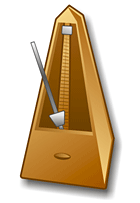
MetronomeFind a flat area and walk for one minute, counting the number of steps you take. Are you a fast walker or a slow walker? I took 115 steps in those 60 seconds and consider myself to be a fairly fast walker. I’m not one to dawdle.

My putting stroke is also fairly quick. I take the club back and through more quickly than some people. My tempo is consistent on long and short putts – just as a pendulum maintains the same period regardless of its arc length.

To find your putting tempo, find a metronome (like the one to the right or an electronic one) and do the walking drill. Set the metronome to your step rate – 25. Stand in place and move your putter through your stroke back and forward, ending each half of the stroke on a tick of the metronome. If the tempo feels too fast, slow it down. Too slow, speed it up. Continue to make small adjustments until you find your perfect putting tempo.

Now, just take it to the course! Keep the same tempo – back and through – on all of your putts. On short putts, you’ll swing more slowly but also have a shorter stroke. Your putter’s just a pendulum, folks, and the tempo remains the same.

Waggle for Tempo

Waggling is a very small swing. How fast you waggle helps to determine your tempo.

Waggling – the movements you make with your club during your pre-shot routine – is more critical than most people assume. It’s under-utilized and important, because it often acts as a miniature (very miniature) version of your full swing.

Watch players with a very fast tempo: odds are they waggle the club in a fast tempo too. Other players look like they’re rocking the clubhead to sleep with their waggles. They’re likely to have a slower tempo.

Use this to your advantage: try waggling more slowly to slow your tempo down a notch. It’s rare that you’ll ever want to speed up your tempo, but should you, simply waggle faster.

When to Practice

When you practice is just as important as how you practice.

When are you more likely to hit the range: after a good round or after a bad one? Golfers are more likely to hit the range after a bad round than a good one, which begs the question: how do you ingrain a good swing if you only practice when you’re not swinging well?

Instead, reverse the two. Practice when you’re playing well. See a pro when you’re not.

If you’d like to find a PGA instructor, use the search engine at pga.com.

Any Wedge from the Sand

The long bunker shot is one of the toughest in golf, and attempting it with a sand wedge will likely leave you in a dreary position.

Lots of times, people get hung up in playing the sand wedge from the sand. If you’re bunkered 30 yards from the pin with a lot of green to work with, take your 9I or even an 8I, don’t worry about the club digging (it will), and make a good swing.

The long bunker shot is one of the toughest in golf, and attempting it with a sand wedge will likely leave you in a dreary position. Take a longer club, a shorter swing, accelerate through the sand, don’t worry about the follow through too much, and play quite a bit of roll.

Between Clubs? Land it on the Green.

When you’re faced with an in-between shot, choose the club that lands the ball on the green.

When you’re between your 7I and your 8I, what kind of shot do you play? A soft 7? Punch an 8? Here’s some practical advice: take the club that will land the ball on the green. If the pin is in the back, take the 8I. If the pin is in the front, take the 7I. Your “normal shot” will be on the green, leaving you with a putt at a birdie.

Putt on a Line

Most putting teachers, including Dave Pelz, recommend a “straight back, straight through” putting stroke. This tip helps you craft a simple line.

Most putting teachers, including Dave Pelz, recommend a “straight back, straight through” putting stroke. Grooving one is easier said than done: there’s no actual line against which you can judge your stroke!

Find yourself some twine or string and a pair of chopsticks. Break the chopsticks in two (so you have two little wooden stakes) and tie the string around the fat portion of each. Find a straight putt and push one stake into the ground behind the hole. Put the other on the straight line about six feet from the hole, keeping the string taut.

The rest is simple: place your ball under the string and both the line on which you want to hit the putt and a line that helps you judge “straight back, straight through” is there for you.

Play Catch

Practicing distance control doesn’t have to be boring: turn it into a fun game of “pitch” and catch.

Practicing distance control doesn’t have to be boring: turn it into a fun game of “pitch” and catch. Get your husband, your son, your wife, daughter, friend, nephew, aunt, or buddy to put on a glove and stand some distance from you. Hit ten shots, allowing your friend to move between shots. Count the number of times your friend can make a catch without moving more than one step in any direction.

Then switch and let your partner try to beat your score. Use any club in the bag and play a range of distances from 20 yards to 100 yards. You will want to win, and so you’ll quickly locate the distance with which your partner has the most difficulty, encouraging him to practice his weak spots (and he yours).