Understanding Bounce

Do you know what bounce is and how it applies to your game? Choosing the right bounce is important in every iron, not just your sand wedge.

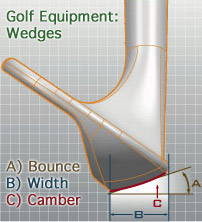
BounceThe sand wedge is perhaps the most famous model, but every club has bounce. Bounce is defined as “the measurement, in degrees, of the angle from the front edge of a club’s sole to lowest point on the club (which rests on the ground).” Players have worried about bounce in their wedges for quite awhile, but it’s important in your other clubs as well.

For example, compare the Titleist 680 and 670. The 680 7I has 3° of bounce, while the 670 has 7.5°. Titleist describes the 680 by saying the “narrow sole, moderate camber and bounce angle are designed for players who like to pick the ball off the turf.” Titleist describes the 670 as by saying “the slightly wider sole with more bounce and camber is designed for players with a more aggressive, steeper swing, and is excellent in softer conditions.”

In other words, your swing shape has a lot to do with the proper bounce, and bounce matters in more than a sand wedge.
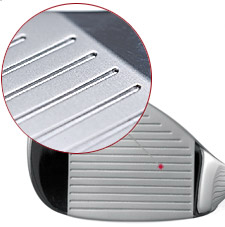
The Purpose of Grooves

Clean your grooves!

GroovesMany people think that grooves exist to impart backspin. This is not true. In tests with Iron Byron, ungrooved irons imparted 98% as much backspin as grooved versions of the same model iron. The main purpose of grooves is to collect dirt, grass, and water, thus increasing ball/steel contact. Think of car tires: in dry weather, racers go with “slicks” and in slightly wet weather, they must use tread. Tread isn’t used to “grab” the pavement, but to channel water away so rubber/cement contact can be maximized. Some deformation of the ball occurs at impact, allowing the grooves to “grab” parts of the ball, and this grabbing accounts for the 2% differential seen in the smooth vs. grooved club test.

Keeping your grooves clean is important in maintaining consistent ball/steel contact, which in turn leads to consistent distance, height, and backspin from your irons. Today’s tip is more science lesson, but the tip is this: keep your grooves clean. Wipe them with a soft towel, clean the grooves with a sharp end of a tee or a groove cleaner, and keep your clubs dry. If your grooves are already filled with water, they won’t do much good.

With “dirty” balls, ungrooved clubs in the Iron Byron test imparted as little as 60% as much spin. Why doesn’t your driver have grooves? Because the ball should be relatively clean when you’re teeing it up.

Photo Credit: © Unknown.

Hybridized Chipping

The next time you find yourself around the green, do as Hamilton does: put that hybrid to work!

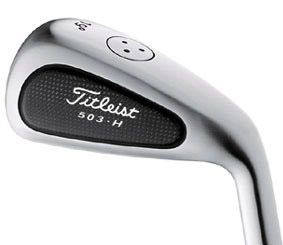
Titleist 503.HLike most of the rest of the golf world, you’ve added a “rescue,” “hybrid,” or “ironwood” to your bag. You use it out of the rough and off the tee, and it works well for you. Guess what? You’re still under-utilizing the club.

As Todd Hamilton showed us at last year’s British Open, the hybrid club is also an effective tool around the greens. You may not get as much use out of it as Hamilton did around the links-style Open course, but from greenside rough and fringes, hybrid clubs possess a number of traits that will help you get the ball closer to the hole.

To play a chip with a hybrid, stand the club up on its toe a little and take a putting grip. Play the shot very much like a putt, with very little wrist action. The hybrid will glide through any grass quite easily, ensuring solid contact.

The next time you find yourself around the green, do as Hamilton does: put that hybrid to work!

Balance Those Balls!

How much does a good ol’ set of balanced balls matter? Quite a bit, it turns out!

Check-GoThis lengthy article at Golf Club Review talks about the value of a spin-balanced golf ball.

A player with a poor stroke may never realize much benefit from the use of balanced balls on the green, but a good putter should be able to reduce his handicap by close to a stroke with careful and sustained use of balance-oriented balls. If he is also adept at using the alignment lines on the ball to aim his putts, he may save substantially more than a stroke a round.

Further reading reveals that Golf Club Review found disparities in long irons, short irons, and driver shots as well. Turns out that balancing a ball is important for more than putting!

You can read more about the Check-Go system here or purchase one from TGW.com or other retailers.

Best Predictors for Performance

What five key stats do the top players in the world have in common?

Risk Reward 18Th Pebble BeachTiger goes for the green. Vijay goes for the green. Phil Mickelson? Yep. Ernie Els? You bet.
According to Jaime Diaz and Steve Evans in a Golf Digest article, careful analysis of Shotlink statistics reveals that five stats in particular are important for high-ranking golfers:

…five others have clearly emerged as leading indicators and predictors of success: “birdie average,” “par breakers,” “par-5 scoring average,” “par-5 birdie percentage” and “going for the green” (the percentage of times a player tries to drive a par 4 or hit a par 5 in two.) In these stats in 2004, the worst ranking recorded by any of the top five players in the world – Vijay Singh, Tiger Woods, Ernie Els, Retief Goosen and Phil Mickelson – was eighth (Goosen in par breakers and Lefty in par-5 birdie percentage). Singh finished first in all but par-5 birdie percentage (Goosen led with 55.3). Woods and Els were in the top five in all five categories.

Your tip of the day? Read the article and apply the knowledge you gain from it to your own game.

Tiger Turns (uhh, 2004 minus 1975 is, uhhh…)

Happy 29th to Tiger Woods, who turns, uhhhh, 29 today.

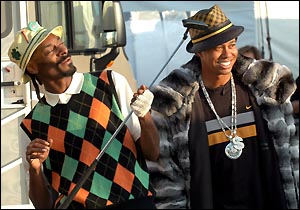
Tiger and SnoopEldrick “Tiger” Woods was born on this day, December 30, in 1975. Happy 29th, Tiger! Reportedly, Tiger slept in late today before a Swedish nanny named Elin cooked him breakfast in bed.
After breakfast, Tiger spent much of the day celebrating with his close pal from da hood, Snoop Doggy Dogg. Woods was overheard joking with Dogg, saying “fo’ shizzle ma 2-dizzle wizzle pizzle.” Dogg and Woods visited a local municipal mini golf facility, where Tiger was schooled on the ways of the Doggy Dogg lifestyle.

The Sand Trap .com tried to catch up with Woods as he was leaving the eighteenth green, but was brushed aside by a Woods determined to properly inflect the phrase “drop it while it’s hot, drop it while it’s hot.”

Said Dogg on Tiger’s departure, “Tiger had to get his fizzle swizzled by his Norwegian bizzle, yo.” The Sand Trap .com wishes Tiger Woods the best on his 29th and wishes him a wonderful 2005.

Oh, and we wish for ourselves the chance to meet Elin’s twin sister. Yeah.

Photo Credits: © Unknown

Black Balls

Nike may be asking its staff players to use black balls during the Sony Open in Hawaii.

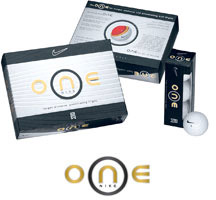
Nike One BlackAccording to GolfWorld, Nike is asking their staff players to use an all-black golf ball at the Sony Open to promote the Nike ONE Black.

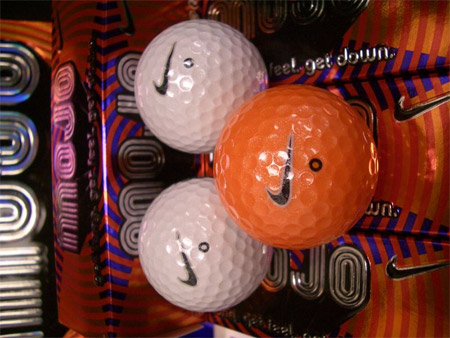
This comes on heels of the rumor that all Nike golf balls – from the ONE to the Mojo and TA lines – will be packaged differently in 2005. The rumor says that Nike golf ball 12-packs will ship with 11 regular white balls and one differently colored ball. In the Mojo line, the ball may be orange (see below) and called the “Karma” ball. In the ONE Black line, it will be black.

Here’s to hoping that Nike never develops the Nike ONE Blue, because, well, that’d just be unfortunate.

Nike Mojo

Forward Ball Position Lowers Flight

Ball flight too high? Try moving the ball forward in your stance. Yes, FORWARD!!

This tip comes from our forums, where jcgolfpro talks about high ball flight as a result of ball position being too far back.

Many are focusing on adding loft which produces a weak shot as the ball slides up the clubface and many times it fades. I have a tendency to hit the ball very high but when I start doing that, I know I have slid the ball too far back in my stance. The one thing some have forgotten is “angle of attack.” When we slide the ball too far back, we get a little steep… many times doesn’t hurt majorly but when playing in the wind, we hit a lot of “ballooned” shots.

However, without seeing, I can’t be sure but you can. If you have access to an impact bag, you can feel it yourself. If not, get a cloth laundry bag and fill it with towels and swing into it (using an old club in case something goes wrong). This will provide immediate feedback on your impact position.

Thanks, JC, for the tip!

Bowen’s Balls

An expensive training aid boiled down to tape and a pencil, the Sand Trap way!

The Golf Blogger posted today about the “Bowen Ball Swing Aid.” The BBSA costs “only” $39.95 and is nothing more than a lucite stick. We’re economical (that’s slang for “not completely stupid”), so we advocate creating your own training aid: glue two dowel rods together (one has to fit into that hole in your grip), fold a coat hanger appropriately, etc. Heck, tape a pencil to the top of your grip if you want.

The images on the BBSA “How it Works” page explain the functionality pretty well: one end of the rod goes on the butt of the club, the other leans out perpendicular to the shaft and parallel to the clubface. Take a normal grip and swing, but don’t let the aid touch your arms. If your swing is overly wristy or gets off-plane near the top of your backswing (laid off or across the line), the coat hanger/dowel/expensive piece of plastic will let you know. You’ll, quite literally, feel it.

Now that you’ve saved roughly $39.67, well, buy yourself a dozen good golf balls.