Bowen’s Balls

An expensive training aid boiled down to tape and a pencil, the Sand Trap way!

The Golf Blogger posted today about the “Bowen Ball Swing Aid.” The BBSA costs “only” $39.95 and is nothing more than a lucite stick. We’re economical (that’s slang for “not completely stupid”), so we advocate creating your own training aid: glue two dowel rods together (one has to fit into that hole in your grip), fold a coat hanger appropriately, etc. Heck, tape a pencil to the top of your grip if you want.

The images on the BBSA “How it Works” page explain the functionality pretty well: one end of the rod goes on the butt of the club, the other leans out perpendicular to the shaft and parallel to the clubface. Take a normal grip and swing, but don’t let the aid touch your arms. If your swing is overly wristy or gets off-plane near the top of your backswing (laid off or across the line), the coat hanger/dowel/expensive piece of plastic will let you know. You’ll, quite literally, feel it.

Now that you’ve saved roughly $39.67, well, buy yourself a dozen good golf balls.

Top 10 Golfers of 2004

The top 10 golfers of 2004 include Meg Mallon, Michelle Wie, Kevin Stadler, and Ryan Moore. Can you guess the other six?

Michelle WieAbout.com has published their list of “Top 10 Golfers of 2004.” The list includes:

  • Tiger Woods
  • Vijay Singh
  • Annika Sorenstam
  • Ernie Els
  • Phil Mickelson
  • Meg Mallon
  • Retief Goosen
  • Kevin Stadler

It also includes a pair of amateurs:

  • Michelle Wie
  • Ryan Moore

How would you vote? Discuss it in the comments or in our forum!

Keep a Diary

Diaries aren’t just for little girls, you know.

Last fall, I began hitting the ball toward the heel a little bit. My swing felt fine, but I wanted solid contact and couldn’t find a swing thought that worked at getting my swing back in the groove. A week or two into my “heel funk” I found my high school golf diary: a hodge-podge of notes, swing thoughts, diagrams of holes, and more. I flipped through and found a perfect swing thought (this tip isn’t about that particular swing thought, so I won’t share it here).

The lesson here is clear: keeping a diary can save your butt down the line. Your golf diary may include information like swing thoughts for the day, information obtained at a recent lesson, general trends (i.e. “hitting slight fade” or “hitting lots of shots thin”), or more. Some golfers might even keep track of their hats so they can identify which is their “luckiest.”

Diaries aren’t just for little girls, you know.

Swing Under a Hedge

Swing under a hedge to flatten out the low spot on your long irons and woods.

Different clubs require different swings. Your wedge, for example, requires a “steeper” swing than your 4I. Your driver and 3W require the sweeping swing of all.

The bottom of a sweeping swing is very flat – the club is just above the ground for two or three feet. To ingrain the feeling of keeping the club low to the ground for a long period of time, imagine swinging your driver under a hedge – don’t clip the wood chips or dirt, and don’t clip the leaves or branches above.

This works well for your driver, 3W, and long irons, but is difficult to manage with mid and short irons.

A Callaway Christmas

Callaway brings out the new stuff – the Big Bertha 454 Titanium Driver and X-18 Series irons.

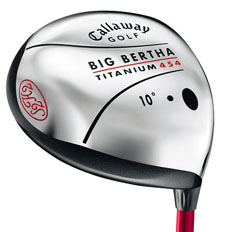
callaway_454_back.jpgCallaway Golf rushed into the holiday season this year by bringing out all kinds of new stuff. First off, as previously noted, the Big Bertha© Titanium 454 Driver (right) has already made a splash by winning the Re/Max World Long Drive Championship televised earlier today. Sticking to the Callaway’s Big Bertha maxim of “when properly engineered, Bigger is Better”, the 454 Driver (that’s 454cc) is Callaway’s largest driver to date, yet by using subtle design curves, gives a surprisingly compact look at address. It is designed to reach the maximum allowable level for springlike effect as measured by the USGA’s new characteristic time (CT) test, and conforms to all USGA Rules.

That may be some good press release rhetoric, but I’m quite anxious to get this puppy on to the driving range.

The next stop on the product tour is the iron department.

Position the Logo to Hit it Straighter

You won’t actually hit the inside back quadrant of the ball, but trying to may help your scores more than you could imagine.

I’ve long employed a simple trick to hit the ball further and straighter: I put the logo (in my case, “Titleist”) on the back inside quadrant of the ball when teeing up. Then, my sole swing thought is “hit the logo with the clubface.”

Obviously, hitting the logo with the clubface would result in a massive hook or a blocked shot 45° right of your target line, but the simple reality is that nobody is that limber. Trying to hit the inside of the ball forces the club to come from just inside the target line – a powerful position that adds accuracy and distance and counters the weak over-the-top move of a lot of amateurs. It can also help to encourage a longer wrist cock, creating more “lag” and thus more powerful shots.

In the fairway, where you’re not able to position the ball, focus on a dimple or a spot in the same quadrant. You won’t actually hit the inside back quadrant of the ball, but trying to may help your scores more than you could imagine.

Bridgestone Challenges Golf Ball Market

Bridgestonge Golf introduces a new line of golf balls and clubs early in 2005 starting with its high end Tour B330 ball.

Bridgestone B330Bridgestone Golf has already grown to become one of the most dominant golf companies in Japan. The company now has its eyes set on the American market and is ready to unveil a new line of golf clubs and balls early in 2005. First to roll off the Bridgestone line is a new top of the line golf ball, the Tour B330. The ball will compete against Titleist’s Pro V1 and V1X golf balls targeted at professionals and better amateurs. Bridgestone claims the ball, “will provide unparalleled distance and accuracy to better players and is less affected by wind than its competitors but does not sacrifice distance and feel.” The Tour B330 has already seen action on tour, Fred Couples used it to win the 2004 Skins Game and has signed on with the company as a pitch man. Couples has agreed to use both the Tour B330 and the company’s soon-to-be introduced J irons.

Hal Sutton and Post Ryder Cup Blues

In the wake of the 2004 Ryder Cup, captain Hal Sutton admits to losing interest in the 2005 PGA season.

Hal SuttonAfter leading the United States Ryder Cup team into a trouncing by the Europeans, captain Hal Sutton admits to having lost some desire to compete on the PGA tour in 2005. The last event Sutton competed in was the Chrysler Championship in October where he failed to make the cut. At the time, Sutton expressed a desire to leave the turmoil of the Ryder Cup behind him and get back to playing golf. However, he recently said, “It’s tough to get back. I’ll be honest with you I’ve lost a little desire.” Sutton is not the first Ryder Cup captain to experience such feelings. Of the five captains that preceded Sutton, only Tom Watson was able to finish in the top 150 on the PGA tour’s money list.

Sutton’s two years of time consuming captaincy in the years preceding the Ryder Cup certainly contributed to his diminished focus. However, Sutton also dealt with a nagging injury in his left palm which required surgery earlier this month. There are also off course distractions tugging at Sutton such as his burgeoning golf course design business and charity work with the Hal Sutton Foundation which just approved plans to build a children’s hospital in Shreveport, Louisiana. While playing golf used to be Sutton’s number one priority, he now says: “One thing I learned by not playing as much this year as I normally do is that I can live with that… But right now, I’m content with the things I’m working on.”

Grip Tips

Play around with your grip, making minor swing changes you feel necessary.

The next time you’re at the range, experiment with your grip. I like to hit shots while I hover my right thumb above the grip. I find that this forces me to swing more with control and to use the bigger muscles of my shoulders, arms, and trunk to control the club, not the small muscles in my wrists and fingers.

You may want to try strengthening your grip. Or weakening it. Try gripping the club more in your fingers or try putting it further back into your palms (my grip tends to work out towards my fingertips sometimes, but that’s rare – most people grip too much in their palms).

Try swinging a club with only your left hand. Switching from an overlap to an interlocking (or vice versa). Jim Furyk uses a double-overlap grip, after all.

Play around with your grip, making minor swing changes you feel necessary. Don’t spend too much time practicing grips that don’t pay off or that feel too awkward, because practice makes permanent. And nobody wants a permanent grip that doesn’t work.