Jump to content
Check out the Spin Axis Podcast! ×
  • entries
    63
  • comments
    496
  • views
    55,096

Winter Golf


bkuehn1952

2,396 views

001 (365x336).jpg

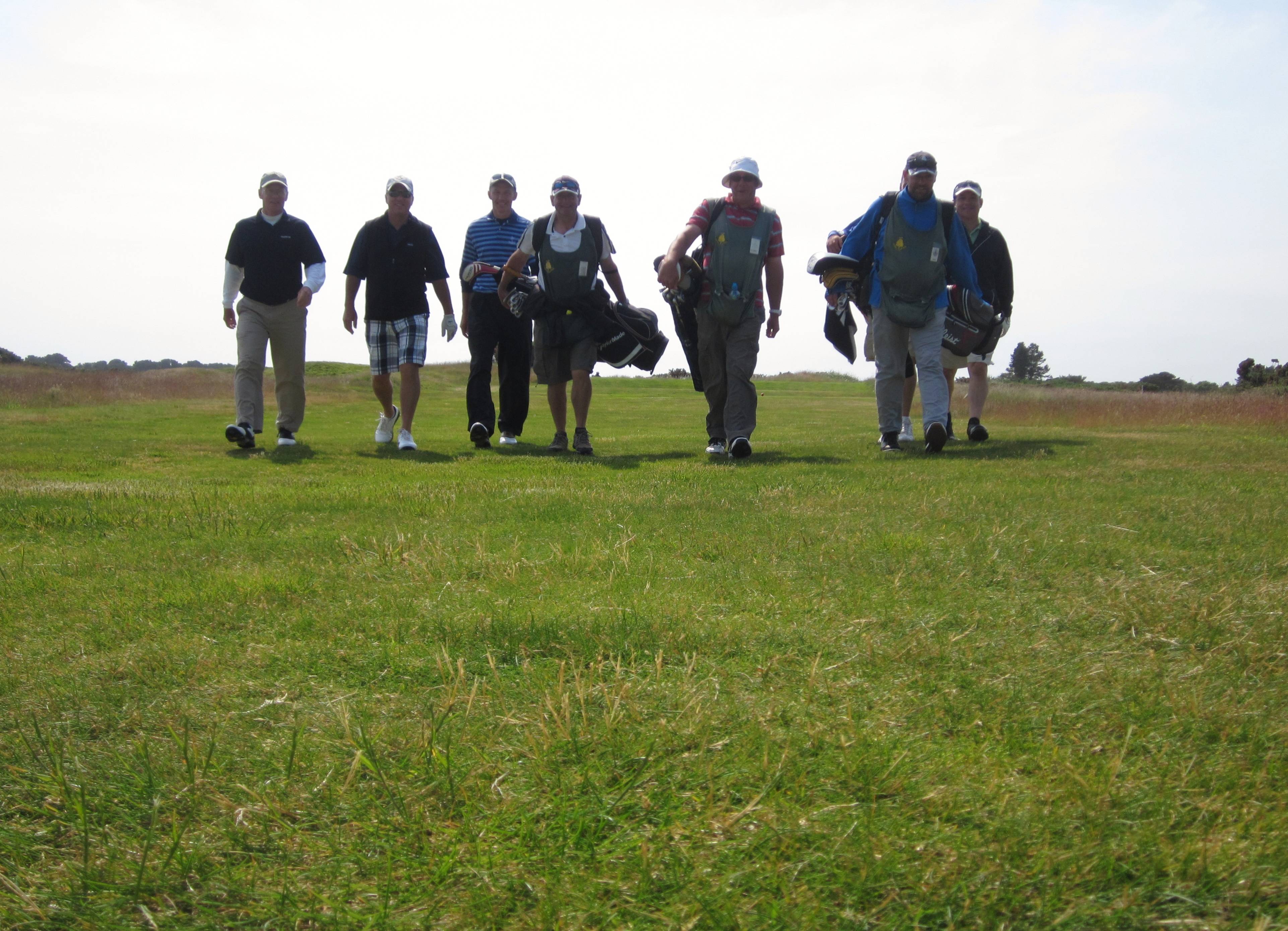
When I use the term “winter golf” I am not talking about trudging through snow drifts and playing orange golf balls.  There are certainly people who engage in that sort of activity and enjoy it.  Hitting out of a snow drift to a rock hard green, however, isn’t close enough to golf for me.  I played in one “Chilly Open” and while it was fun there was no need to repeat that experience.

“Winter golf” to me is the time period in SE Michigan that starts around Thanksgiving and ends when snow blankets the turf.  Many courses have closed by 11/1.  Often the rakes, ball washers, tee markers, waste cans and even the benches are removed.  Greens are no longer mown and hole locations are not re-cut.  Getting around the course reverts to walking or pushing since the carts are safely stored in the cart barn.

Despite the rough conditions, this time of the year is very rewarding.  The cost of golf plummets.  One will often find the course empty so hitting multiple balls and bunker practice can be done easily without the worry of holding up someone else.

My advice for those in the northern tier who want to partake of this cold feast is:

1. Learn which courses remain open – this seems simple but often it is hard to find an open course.  And the lineup of winter courses changes year to year.  In my area, the reliable place for winter golf is Fox Hills.  They only close when snow covers the course or torrential rains turn it into a bog.  An added benefit is they have 27 holes so everyone isn’t packed into just 9 or 18 holes.

2. Own a lightweight golf bag – one is going to be walking & carrying or pushing one’s bag.  It is a lot easier to manage a 25 pound load versus a 50 pound one.  It is pretty comical to watch an out of shape guy lugging a staff bag on his back filled with 16 clubs and 3 dozen balls.

3. Bring your own water – Even when it is 35 degrees, you need to stay hydrated.  Beer works too, but if you want to get really buzzed, maybe just stay home and watch golf on TV. 

4. Retain an old pair of water proof shoes – It is going to be muddy and wet.  There is no point in ruining a new pair of kicks.  A “mudder” pair of shoes is a good thing to have.  Water proof is also essential as courses will be soggy.

5.Learn where one can jump holes - To get around the inevitable 6-some of plodders who won’t let others play through, know the short cuts.  There is no calling the clubhouse to get a ranger out so you need to make your own solution.  I once played a round in this order: 1, 2, 13, 14, 12, 3, 4, 5, 6, 7, 10, 11, 15, 16, 17, 18, 8, 9.  I never had to walk more than 20-40 yards between holes.

6. Lower your standards – If you are looking for a top notch course, they rarely allow play when winter sets in.  You are most likely going to be playing somewhere you would never visit in July.

7. Lower your expectations – Balls don’t fly as far and almost every lie is marginal.  Greens are slow & bumpy and the last time a new hole was cut was 2 months ago.   Enjoy the fact that you are outside and swinging a club.

8. Dress for comfort and the ability to swing a golf club – If you need a down parka to feel comfortable, you may want to skip winter golf.  Bulky clothes and golf don’t mix well.  I favor a rain suit worn over long underwear and sweater along with a sock hat.  Walking will keep you warm.  There are numerous modern fabrics that make cold weather very livable.

This list is by no means all inclusive.  Most winter golfers have great advice about hand warmers and such.  Ultimately, the winter golfer will figure out what works and what doesn’t.

Any additional suggestions from our northern winter warriors?


2 Comments


Recommended Comments

GolfLug

Posted

Warm hands!! CANNOT forget those. My biggest issue is retaining feeling (especially my left hand fingers) after 7-8 holes when cold starts setting into the fingers when it's below 35 F. If the wind is blowing even below 45 F can slowly work the feel out of fingers.

The big muffs + heat pouch do the trick.


mcanadiens

Posted

You hit most of the major points. ... Just to the south of you, we occasionally get decent days even at this point of the year. The weather-guessers are saying 50 degrees on Saturday, Hope they are right this time.

Create an account or sign in to comment

You need to be a member in order to leave a comment

Create an account

Sign up for a new account in our community. It's easy!

Register a new account

Sign in

Already have an account? Sign in here.

Sign In Now


  • Want to join this community?

    We'd love to have you!

    Sign Up
  • Blog Entries

  • Posts

    • Please see this topic for updated information:
    • Please see this topic for updated information:
    • When you've been teaching golf as long as I have, you're going to find that you can teach some things better than you previously had, and you're probably going to find some things that you taught incorrectly. I don't see that as a bad thing — what would be worse is refusing to adapt and grow given new information. I've always said that my goal with my instruction isn't to be right, but it's to get things right. To that end, I'm about five years late in issuing a public proclamation on something… When I first got my GEARS system, I immediately looked at the golf swings of the dozens and dozens of Tour players for which I suddenly had full 3D data. I created a huge spreadsheet showing how their bodies moved, how the club moved, at various points in the swing. I mapped knee and elbow angles, hand speeds, shoulder turns and pelvis turns… etc. I re-considered what I thought I knew about the golf swing as performed by the best players. One of those things dated back to the earliest days: that you extend (I never taught "straighten" and would avoid using that word unless in the context of saying "don't fully straighten") the trail knee/leg in the backswing. I was mislead by 2D photos from less-than-ideal camera angles — the trail leg rotates a bit during the backswing, and so when observing trail knee flex should also use a camera that moves to stay perpendicular to the plane of the ankle/knee/hip joint. We have at least two topics here on this (here and here; both of which I'll be updating after publishing this) where @mvmac and I advise golfers to extend the trail knee. Learning that this was not right is one of the reasons I'm glad to have a 3D system, as most golfers generally preserve the trail knee flex throughout the backswing. Data Here's a video showing an iron and a driver of someone who has won the career slam: Here's what the graph of his right knee flex looks like. The solid lines I've positioned at the top of the backswing (GEARS aligns both swings at impact, the dashed line). Address is to the right, of course, and the graph shows knee flex from the two swings above. The data (17.56° and 23.20°) shows where this player is in both swings (orange being the yellow iron swing, pink the blue driver swing). You can see that this golfer extends his trail knee 2-3°… before bending it even more than that through the late backswing and early downswing. Months ago I created a quick Instagram video showing the trail knee flex in the backswing of several players (see the top for the larger number): Erik J. Barzeski (@iacas) • Instagram reel GEARS shares expert advice on golf swing technique, focusing on the critical backswing phase. Tour winners and major champions reveal the key to a precise and powerful swing, highlighting the importance of... Here are a few more graphs. Two LIV players and major champions: Two PGA Tour winners: Two women's #1 ranked players: Two more PGA Tour winners (one a major champ): Two former #1s, the left one being a woman, the right a man, with a driver: Two more PGA Tour players: You'll notice a trend: they almost all maintain roughly the same flex throughout their backswing and downswing. The Issues with Extending the Trail Knee You can play good golf extending (again, not "straightening") the trail knee. Some Tour players do. But, as with many things, if 95 out of 100 Tour players do it, you're most likely better off doing similarly to what they do. So, what are the issues with extending the trail knee in the backswing? To list a few: Pelvic Depth and Rotation Quality Suffers When the trail knee extends, the trail leg often acts like an axle on the backswing, with the pelvis rotating around the leg and the trail hip joint. This prevents the trail side from gaining depth, as is needed to keep the pelvis center from thrusting toward the ball. Most of the "early extension" (thrust) that I see occurs during the backswing. Encourages Early Extension (Thrust) Patterns When you've thrust and turned around the trail hip joint in the backswing, you often thrust a bit more in the downswing as the direction your pelvis is oriented is forward and "out" (to the right for a righty). Your trail leg can abduct to push you forward, but "forward" when your pelvis is turned like that is in the "thrust" direction. Additionally, the trail knee "breaking" again at the start of the downswing often jumps the trail hip out toward the ball a bit too much or too quickly. While the trail hip does move in that direction, if it's too fast or too much, it can prevent the lead side hip from getting "back" at the right rate, or at a rate commensurate with the trail hip to keep the pelvis center from thrusting. Disrupts the Pressure Shift/Transition When the trail leg extends too much, it often can't "push" forward normally. The forward push begins much earlier than forward motion begins — pushing forward begins as early as about P1.5 to P2 in the swings of most good golfers. It can push forward by abducting, again, but that's a weaker movement that shoves the pelvis forward (toward the target) and turns it more than it generally should (see the next point). Limits Internal Rotation of the Trail Hip Internal rotation of the trail hip is a sort of "limiter" on the backswing. I have seen many golfers on GEARS whose trail knee extends, whose pelvis shifts forward (toward the target), and who turn over 50°, 60°, and rarely but not never, over 70° in the backswing. If you turn 60° in the backswing, it's going to be almost impossible to get "open enough" in the downswing to arrive at a good impact position. Swaying/Lateral Motion Occasionally a golfer who extends the trail knee too much will shift back too far, but more often the issue is that the golfer will shift forward too early in the backswing (sometimes even immediately to begin the backswing), leaving them "stuck forward" to begin the downswing. They'll push forward, stop, and have to restart around P4, disrupting the smooth sequence often seen in the game's best players. Other Bits… Reduces ground reaction force potential, compromises spine inclination and posture, makes transition sequencing harder, increases stress on the trail knee and lower back… In short… It's not athletic. We don't do many athletic things with "straight" or very extended legs (unless it's the end of the action, like a jump or a big push off like a step in a running motion).
    • Day 135 12-25 Wide backswing to wide downswing drill. Recorder and used mirror. 
×
×
  • Create New...

Important Information

Welcome to TST! Signing up is free, and you'll see fewer ads and can talk with fellow golf enthusiasts! By using TST, you agree to our Terms of Use, our Privacy Policy, and our Guidelines.