Jump to content
Check out the Spin Axis Podcast! ×
Note: This thread is 6168 days old. We appreciate that you found this thread instead of starting a new one, but if you plan to post here please make sure it's still relevant. If not, please start a new topic. Thank you!

Recommended Posts

Posted

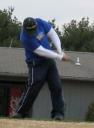
Instead of trying to characterize my swing in terms of "one plane" or "two plane" let me use the swing planes of two PGA pros who I believe are complete extremes in terms of the swing plane: Anthony Kim & Sean O'Hair. Both are young and have had success on the tour. Kim's swing is rounder (flat) while O'Hair's swing has a pronounced vertical element to it (steep).

When I started playing golf, my swing plane was naturally flatter (Kim), albeit I had and still do have many critical flaws. I found that with a flatter swing I drove the ball straighter, and could really go at the ball hard when I wanted to. The motion just seemed simpler. This past summer, I desperately sought instruction to cure my swing woes. Prior to this lesson, I did not know any better. In one hour, my instructor had changed my swing from a flat swing to a very upright swing (O'Hair). At the top of my swing, it felt as if the shaft was inches above my head (although in reality it was not). He had me hitting balls with a David Leadbetter drill in which with the butt of the club pointing towards target, and shaft parallel with the target line, you preset the wrists and swing your arms to the top so that the club is pointing at the target. It was incredibly difficult for me to do. It felt too steep. This drill was supposed to ingrain the feeling of the correct position at the top (derived from swing plane) and it did. Upon learning this drill in that one hour session, I was hitting the best mid-short irons in my life. It was for the most part, enlightening. For the first time in my life, I was truly experiencing what it was to compress the ball. Pured shots coming off my forged Mizunos were bliss. To this day, I still have not replicated that kind of ball striking. While the results with the mid-short irons were awesome, the driver was dismal. I was constantly hitting fades, slices, weak pushes and could not turn the ball over for the life of me. As the clubs got longer (long irons, hybrids, woods) I was everywhere, left right you name it. It's interesting to hear Stacey articulate:
. . .When I make a conscious effort to lift the club (about halfway back) it seems that I have to pause at the top a little longer. I try not to have any swing thoughts coming down other than to get my right elbow tight against my hip. . .

I can empathize with you exactly. With a "Two-Plane" swing I think I know why. Let's recall that a steep swing such as O'Hair's has a pronounced vertical movement (back and up). At the top, that little "pause" lets the club fall down to the correct plane before you proceed through impact. (Back and up, then down and through) Without that pause, O'Hair would swing over the top. A steep swing plane creates leverage and feels powerful. However, in truth it is a swing dependent on timing. Under pressure, I could never time it well. After months of frustrating trials, I reverted back to a flatter swing. I truly believe that it is more efficient and under pressure, more reliable. However, the lesson was not in vain. I learned the importance of the swing plane in the golf swing. Props to O'Hair for making it work, I admire that.
You don't know what pressure is until you've played for five dollars a hole with only two in your pocket - Lee Trevino

MP-600 @ 10.5°
Insight BUL 3-wood @ 15°
Insight BUL 5-wood @ 18° IDEA a2 4i Hybrid @ 23° MX-25 5-PW MP-R Series 52° > 50°/05° MP-R Series 54°/10° MP-R...

Posted
I found when I started golf and didn't have enough knowledge and not enough money to go to an instructor that I went the more 2 plane route.It's because I was exposed to pictures or slo mo clips of this.

I found that longer clubs went all over the place,woods especially sliced into the next county.After 6 months of slicing it hit me that I could replicate my tennis forehand in my golf swing.In the forehand I was obviously coming from below to a higher finish over my shoulder blade,but the idea of plane wasn't alien and because of tennis,it was a natural feeling.

Then I stumbled onto golflink one day and happened onto Mike LaBauve and his advice,and then onto buying Jim Hardy's book The Plane Truth.

The thing is even LaBauve and Hardy and Ritter who have all worked together look slightly different in their swings and from my own experience you will end up with elements of your own style of swinging based on your personal body type and what feels natural to your body.

"Repetition is the chariot of genius"

Driver: BENROSS VX PROTO 10.5
Woods: BENROSS QUAD SPEED FAIRWAY 15"
Hybrids:BENROSS 3G 17" BENROSSV5 Escape 20"
Irons: :wilson: DEEP RED Fluid Feel  4-SW
Putter: BENROSS PURE RED
Balls: :wilsonstaff:  Ti DNA


Note: This thread is 6168 days old. We appreciate that you found this thread instead of starting a new one, but if you plan to post here please make sure it's still relevant. If not, please start a new topic. Thank you!

Create an account or sign in to comment

You need to be a member in order to leave a comment

Create an account

Sign up for a new account in our community. It's easy!

Register a new account

Sign in

Already have an account? Sign in here.

Sign In Now


  • Want to join this community?

    We'd love to have you!

    Sign Up
  • TST Partners

    PlayBetter
    Golfer's Journal
    ShotScope
    The Stack System
    FitForGolf
    FlightScope Mevo
    Direct: Mevo, Mevo+, and Pro Package.

    Coupon Codes (save 10-20%): "IACAS" for Mevo/Stack/FitForGolf, "IACASPLUS" for Mevo+/Pro Package, and "THESANDTRAP" for ShotScope. 15% off TourStriker (no code).
  • Posts

    • Day 11: did mirror work for a while. Worked on the same stuff. 
    • I'm not sure you're calculating the number of strokes you would need to give correctly. The way I figure it, a 6.9 index golfer playing from tees that are rated 70.8/126 would have a course handicap of 6. A 20-index golfer playing from tees that are rated 64/106 would have a course handicap of 11. Therefore, based on the example above, assuming this is the same golf course and these index & slope numbers are based on the different tees, you should only have to give 5 strokes (or one stroke on the five most difficult holes if match play) not 6. Regardless, I get your point...the average golfer has no understanding of how the system works and trying to explain it to people, who haven't bothered to read the documentation provided by either the USGA or the R&A, is hopeless. In any case, I think the WHS as it currently is, does the best job possible of leveling the playing field and I think most golfers (obviously, based on the back & forth on this thread, not all golfers) at least comprehend that.   
    • Day 115 12-5 Skills work tonight. Mostly just trying to be more aware of the shaft and where it's at. Hit foam golf balls. 
    • Day 25 (5 Dec 25) - total rain day, worked on tempo and distance control.  
    • Yes it's true in a large sample like a tournament a bunch of 20 handicaps shouldn't get 13 strokes more than you. One of them will have a day and win. But two on one, the 7 handicap is going to cover those 13 strokes the vast majority of the time. 20 handicaps are shit players. With super high variance and a very asymmetrical distribution of scores. Yes they shoot 85 every once in a while. But they shoot 110 way more often. A 7 handicap's equivalent is shooting 74 every once in a while but... 86 way more often?
×
×
  • Create New...

Important Information

Welcome to TST! Signing up is free, and you'll see fewer ads and can talk with fellow golf enthusiasts! By using TST, you agree to our Terms of Use, our Privacy Policy, and our Guidelines.