
Jump to content
Check out the Spin Axis Podcast! ×
  • entries
    57
  • comments
    772
  • views
    41,810

A Tweet Regarding the Length of the Backswing


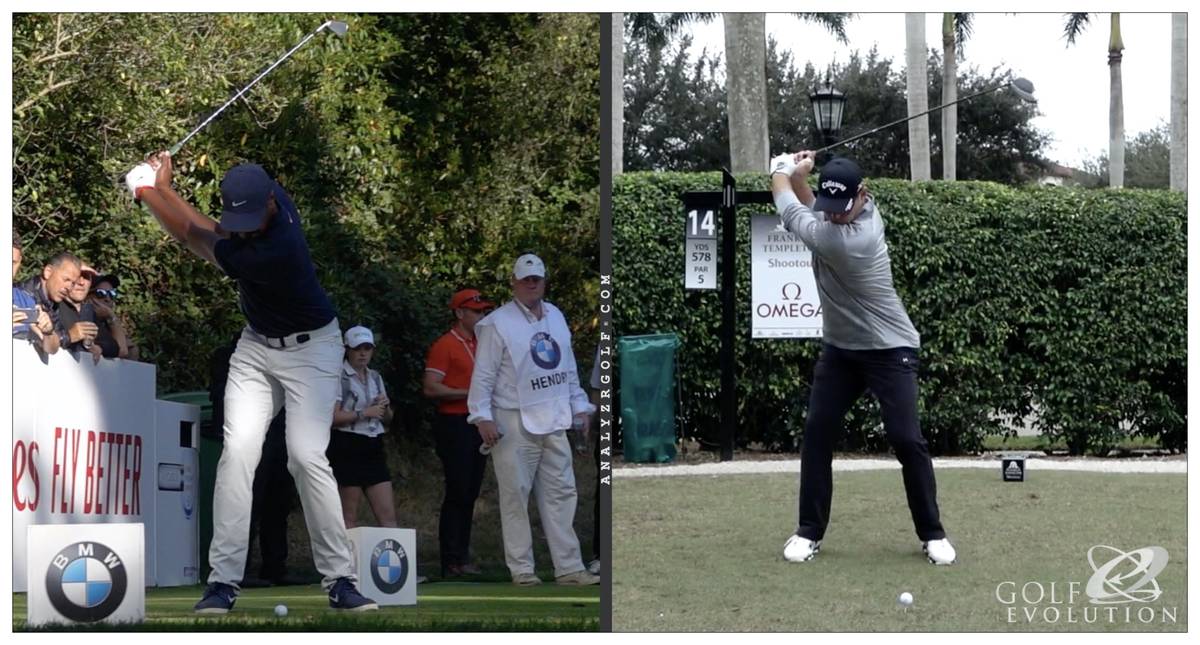
The point of the backswing is to turn your body and to slightly bend your trail elbow, to elevate your trail elbow (to varying degrees), and to hinge your wrists (to varying degrees).

The first bit — what's commonly called "turning your shoulders" — is the most important.

Getting the club to parallel is not even on the list.
FinauWoodland.jpg

  • Like 1
  • Thumbs Up 1

13 Comments


Recommended Comments

Hardspoon

Posted (edited)

Interesting topic, and relevant to my swing (in the “opposite” direction).

One of my problems is not turning enough in the backswing (which also doesn’t let me get the wrists hunted properly), and @iacas has always simply said “finish turning” (shoulders).

No mention of the shaft getting to parallel. 

Edited by Hardspoon
colin007

Posted

The second comment in response to the original tweet says a lot also, showing that he read the tweet and still doesn't understand that a full swing =/= going to parallel

  • Administrator
iacas

Posted

12 minutes ago, colin007 said:

The second comment in response to the original tweet says a lot also, showing that he read the tweet and still doesn't understand that a full swing =/= going to parallel

Yeah I was just about to reply to that.

klineka

Posted (edited)

I can relate to this, one of the things my instructor worked with me on (and is still a work in progress) is stopping my arms when my turn was done. I had a bad habit of completing the shoulder turn, but the hands and arms would continue to go up and back well after my turn was completed. When I feel like my swing length looks like Finau's, my strike is much more solid and consistent, especially with the irons.

Edited by klineka
  • Moderator
TN94z

Posted

It is funny that this post came up during this time. In my last lesson, we worked on shortening my swing. We had tired this prior to last week because I felt as though it was too long and the way I was getting there is what brought my troubles into the picture. We finally figured out a feel that shortens it quite a bit and gets me in much better positions without having to "think" shorten your swing..  The results were, better positions, MUCH better contact, MUCH more control, and the same (if not longer) distance with a more penetrating ball flight. One of the best changes that has happened in my swing.

  • Moderator
nevets88

Posted

More than a few long hitters, like Finau and Rahm and Champ don't get to parallel with their stock swings. Maybe Champ a little bit with the driver, but that's driver. When I have time, I'll look at all the longer hitters on Tour, but I suspect a lot of them don't get to parallel. You'd think that might have an influence on the to parallel idea. I wonder, pre 2000, more swings that went to parallel?

RFKFREAK

Posted

I don't watch much golf anymore but I don't really see the pros getting to shaft parallel.  I've never consciously tried to and I think I only do with my driver 

colin007

Posted

6 hours ago, TN94z said:

It is funny that this post came up during this time. In my last lesson, we worked on shortening my swing. We had tired this prior to last week because I felt as though it was too long and the way I was getting there is what brought my troubles into the picture. We finally figured out a feel that shortens it quite a bit 

What was the feel that worked for you?

  • Moderator
TN94z

Posted

On 9/15/2020 at 2:29 PM, colin007 said:

What was the feel that worked for you?

It was basically feeling like I was driving my right leg (right handed) into the ground on my back swing and keeping some flex instead of extending it to almost lockout like I was previously doing. This physically limits me to a shorter back swing. I am just not flexible enough to have this move and swing any further. But "for me" this is perfect because it allows my shaft/club face/arm positioning to get in a much better position. The other feel that I do not think about, but it happens naturally, is that it almost feels like my legs move apart rather than my lead knee moving towards the trail leg in my back swing. My first fear was that the shorter back swing would hurt my distance but the better contact that I am making now easily matches the distance with a much better ball flight. This lower body change also makes hitting the correct swing path easier to achieve with less manipulation so it will make the other changes that need to happen in my swing much easier to reach. Obviously, this is what has been working for me and the problem I was having in my swing. I am a big feel player so it is hard for me to make a swing change if I cannot find a specific feeling that I can recognize that puts me into the right position. 

colin007

Posted

6 hours ago, TN94z said:

It was basically feeling like I was driving my right leg (right handed) into the ground on my back swing and keeping some flex instead of extending it to almost lockout like I was previously doing. This physically limits me to a shorter back swing. I am just not flexible enough to have this move and swing any further. But "for me" this is perfect because it allows my shaft/club face/arm positioning to get in a much better position. The other feel that I do not think about, but it happens naturally, is that it almost feels like my legs move apart rather than my lead knee moving towards the trail leg in my back swing. My first fear was that the shorter back swing would hurt my distance but the better contact that I am making now easily matches the distance with a much better ball flight. This lower body change also makes hitting the correct swing path easier to achieve with less manipulation so it will make the other changes that need to happen in my swing much easier to reach. Obviously, this is what has been working for me and the problem I was having in my swing. I am a big feel player so it is hard for me to make a swing change if I cannot find a specific feeling that I can recognize that puts me into the right position. 

So are you saying this lower body restriction via the right knee prevents you from letting the arms cross the chest too much? Were your shoulders turning more than 90 degrees?

  • Moderator
TN94z

Posted (edited)

17 hours ago, colin007 said:

So are you saying this lower body restriction via the right knee prevents you from letting the arms cross the chest too much? Were your shoulders turning more than 90 degrees?

No. The lower body being in this position stops my trail leg from locking out, my lead leg from sliding towards my trail leg, and my arm swing from being too long which gets to a point that the lead arm collapses. It also limits the amount of hip turn I can have. I was trying too hard to get a lot of hip turn at the expense of swing path. I have always tried to shorten my swing by "thinking" about a shorter swing but it just never worked consistently. My shoulders may have been a little greater than 90.

My teacher told me that I was exaggerating the hip turn in my back swing too much. I never really realized how far I was trying to turn my hips until we put the alignment rod in my belt loops. The arms are moving the same as before. My full swing point is just much earlier than it was before. For me, this has led to less manipulation and having a huge "timing" factor in my swing. I feel in much more control of the swing now. I may not be explaining this the best.. I feel like I am working more into my trail knee than around it. Kinda like it is now using the ground for power instead of me trying to " arm swing" faster for power...if that makes any sense.

Edited by TN94z
colin007

Posted

36 minutes ago, TN94z said:

No. The lower body being in this position stops my trail leg from locking out, my lead leg from sliding towards my trail leg, and my arm swing from being too long which gets to a point that the lead arm collapses. It also limits the amount of hip turn I can have. I was trying too hard to get a lot of hip turn at the expense of swing path. I have always tried to shorten my swing by "thinking" about a shorter swing but it just never worked consistently. My shoulders may have been a little greater than 90.

My teacher told me that I was exaggerating the hip turn in my back swing too much. I never really realized how far I was trying to turn my hips until we put the alignment rod in my belt loops. The arms are moving the same as before. My full swing point is just much earlier than it was before. For me, this has led to less manipulation and having a huge "timing" factor in my swing. I feel in much more control of the swing now. I may not be explaining this the best.. I feel like I am working more into my trail knee than around it. Kinda like it is now using the ground for power instead of me trying to " arm swing" faster for power...if that makes any sense.

Oh ok, so it sounds like it was never an issue of your arms traveling too far or continuing to travel after the shoulders have completed their turn - which is definitely an issue for me. I'm flexible and am only now beginning to understand that keeping the arms more centered to my torso is important, and not to let my arms cross my chest like Gumby even tho the lead arm is completely straight

gjunkie57

Posted

Thinking L to L helps me sync my swing and the ball flight is much better.  I too have a backswing sooo long that it sways me off the ball.  The L-2-L drill and thinking slow backswing like Matsuyama is helping.  

Create an account or sign in to comment

You need to be a member in order to leave a comment

Create an account

Sign up for a new account in our community. It's easy!

Register a new account

Sign in

Already have an account? Sign in here.

Sign In Now


  • Want to join this community?

    We'd love to have you!

    Sign Up
  • Blog Entries

  • Posts

    • Day 1: 2025.12.26 Worked on LH position on grip, trying to keep fingers closer to perpendicular to the club. Feels awkward but change is meant to.
    • Please see this topic for updated information:
    • Please see this topic for updated information:
    • When you've been teaching golf as long as I have, you're going to find that you can teach some things better than you previously had, and you're probably going to find some things that you taught incorrectly. I don't see that as a bad thing — what would be worse is refusing to adapt and grow given new information. I've always said that my goal with my instruction isn't to be right, but it's to get things right. To that end, I'm about five years late in issuing a public proclamation on something… When I first got my GEARS system, I immediately looked at the golf swings of the dozens and dozens of Tour players for which I suddenly had full 3D data. I created a huge spreadsheet showing how their bodies moved, how the club moved, at various points in the swing. I mapped knee and elbow angles, hand speeds, shoulder turns and pelvis turns… etc. I re-considered what I thought I knew about the golf swing as performed by the best players. One of those things dated back to the earliest days: that you extend (I never taught "straighten" and would avoid using that word unless in the context of saying "don't fully straighten") the trail knee/leg in the backswing. I was mislead by 2D photos from less-than-ideal camera angles — the trail leg rotates a bit during the backswing, and so when observing trail knee flex should also use a camera that moves to stay perpendicular to the plane of the ankle/knee/hip joint. We have at least two topics here on this (here and here; both of which I'll be updating after publishing this) where @mvmac and I advise golfers to extend the trail knee. Learning that this was not right is one of the reasons I'm glad to have a 3D system, as most golfers generally preserve the trail knee flex throughout the backswing. Data Here's a video showing an iron and a driver of someone who has won the career slam: Here's what the graph of his right knee flex looks like. The solid lines I've positioned at the top of the backswing (GEARS aligns both swings at impact, the dashed line). Address is to the right, of course, and the graph shows knee flex from the two swings above. The data (17.56° and 23.20°) shows where this player is in both swings (orange being the yellow iron swing, pink the blue driver swing). You can see that this golfer extends his trail knee 2-3°… before bending it even more than that through the late backswing and early downswing. Months ago I created a quick Instagram video showing the trail knee flex in the backswing of several players (see the top for the larger number): Erik J. Barzeski (@iacas) • Instagram reel GEARS shares expert advice on golf swing technique, focusing on the critical backswing phase. Tour winners and major champions reveal the key to a precise and powerful swing, highlighting the importance of... Here are a few more graphs. Two LIV players and major champions: Two PGA Tour winners: Two women's #1 ranked players: Two more PGA Tour winners (one a major champ): Two former #1s, the left one being a woman, the right a man, with a driver: Two more PGA Tour players: You'll notice a trend: they almost all maintain roughly the same flex throughout their backswing and downswing. The Issues with Extending the Trail Knee You can play good golf extending (again, not "straightening") the trail knee. Some Tour players do. But, as with many things, if 95 out of 100 Tour players do it, you're most likely better off doing similarly to what they do. So, what are the issues with extending the trail knee in the backswing? To list a few: Pelvic Depth and Rotation Quality Suffers When the trail knee extends, the trail leg often acts like an axle on the backswing, with the pelvis rotating around the leg and the trail hip joint. This prevents the trail side from gaining depth, as is needed to keep the pelvis center from thrusting toward the ball. Most of the "early extension" (thrust) that I see occurs during the backswing. Encourages Early Extension (Thrust) Patterns When you've thrust and turned around the trail hip joint in the backswing, you often thrust a bit more in the downswing as the direction your pelvis is oriented is forward and "out" (to the right for a righty). Your trail leg can abduct to push you forward, but "forward" when your pelvis is turned like that is in the "thrust" direction. Additionally, the trail knee "breaking" again at the start of the downswing often jumps the trail hip out toward the ball a bit too much or too quickly. While the trail hip does move in that direction, if it's too fast or too much, it can prevent the lead side hip from getting "back" at the right rate, or at a rate commensurate with the trail hip to keep the pelvis center from thrusting. Disrupts the Pressure Shift/Transition When the trail leg extends too much, it often can't "push" forward normally. The forward push begins much earlier than forward motion begins — pushing forward begins as early as about P1.5 to P2 in the swings of most good golfers. It can push forward by abducting, again, but that's a weaker movement that shoves the pelvis forward (toward the target) and turns it more than it generally should (see the next point). Limits Internal Rotation of the Trail Hip Internal rotation of the trail hip is a sort of "limiter" on the backswing. I have seen many golfers on GEARS whose trail knee extends, whose pelvis shifts forward (toward the target), and who turn over 50°, 60°, and rarely but not never, over 70° in the backswing. If you turn 60° in the backswing, it's going to be almost impossible to get "open enough" in the downswing to arrive at a good impact position. Swaying/Lateral Motion Occasionally a golfer who extends the trail knee too much will shift back too far, but more often the issue is that the golfer will shift forward too early in the backswing (sometimes even immediately to begin the backswing), leaving them "stuck forward" to begin the downswing. They'll push forward, stop, and have to restart around P4, disrupting the smooth sequence often seen in the game's best players. Other Bits… Reduces ground reaction force potential, compromises spine inclination and posture, makes transition sequencing harder, increases stress on the trail knee and lower back… In short… It's not athletic. We don't do many athletic things with "straight" or very extended legs (unless it's the end of the action, like a jump or a big push off like a step in a running motion).
    • Day 135 12-25 Wide backswing to wide downswing drill. Recorder and used mirror. 
×
×
  • Create New...

Important Information

Welcome to TST! Signing up is free, and you'll see fewer ads and can talk with fellow golf enthusiasts! By using TST, you agree to our Terms of Use, our Privacy Policy, and our Guidelines.