Many of you know that I'm a big fan of the shoes made by TRUE Linkswear (http://www.truelinkswear.com/). Only recently, when talking about the new phx models that are now available, did a few things really come together for me.
Throughout my life I've been a "barefoot" kinda guy. I spent most of my summer barefooted and running around the yard and even across the tarred and chipped street in front of my house. When I wore shoes in high school they were always oversized - I hated feeling like my toes were squished or held together. After college I worked for myself or for companies with relatively loose dress codes (web and software development doesn't tend to require a lot of suits and ties). I routinely wore sandals to work or, when working for myself, wore nothing on my feet.
In fact, outside of my hockey skates, which I like to be very tight to my foot, I've never really "bound" my feet at all.
I've recently gotten into running and there's a movement or a rebirth of understanding (depending on how you look at it) in the running and shoe industry about how shoes should work to best serve our feet. Since the 1960s or 1970s the shoe industry has, by and large, been adding to shoes. They've added cushioning. They've added "control." They've added "stability" features. Air. Springs. Padding. They've added more padding to the heels of shoes than the forefoot area of the shoes. In fact, many "modern" shoes have as much as 15-20mm difference in height between your forefoot and your heel. More and more we've removed control and tried to make our shoes "handle" the oh so difficult task of walking or running or playing sports.
The problem with that line of thinking is this: our bodies have evolved to do these tasks - running and walking - pretty well on their own. No, this isn't an argument against specialized shoes like cleats for better traction or something like that - but it is an argument for a shoe that reduces the amount of "shoe" you've got. It's an argument for returning control to our feet.
Many people view their feet as the ugly things attached to their legs. While I'm not in any way particularly attracted to feet (not that there's anything wrong with that, whatever floats your boat! :D), I do marvel at their evolved form. It's often said that we share 98% or whatever of our DNA with gorillas (or apes, or monkeys, or whatever), but our feet for example are very, very different. Our feet contain 52 bones, 66 joints, and 40 muscles. The design that's evolved allows us to run incredible distances (people have run over 100 miles barefooted in 24-hour races). The arch, the heel, the length, shape, and size of your toes have all come about because man evolved to walk and run.
There have been some recent studies showing that the "modern" shoe - with all of its cushioning and support and control - is causing more injuries than ever, despite being sold and marketed as helping to prevent those same injuries. Our feet are being weakened because more of their responsibilities - more of their "work" - is being offloaded to a shoe.
Great, right? Except studies show the opposite is true. When our feet are weaker, they're more likely to get injured regardless of the shoe you're wearing at that time. When our feet get weaker, even walking produces more forces and
I read of one study where participants jumped barefooted from a platform to a layer of cushioning a few feet below them. The participants were asked to jump from several different platforms, and they were told the cushioning beneath them of varying levels of firmness ("this one is the softest" or "this one is really firm"). In reality all of the foams were the exact same, but they found that people landed with MORE force when they were told the foam was softest. When they were told the foam was firmest, they used their bodies (feet, knees, etc.) to soften the impact, and conversely, landed with the LEAST force when they believed the cushioning to be the firmest.
This is what happens to our shoes. When we are given incredibly squishy shoes, particularly when the padding exists excessively in the heels - we actually generate more force when walking or running than we do when running barefooted! Building up the heel of our shoes with cushioning encourages exaggerated "heel striking" - landing harshly on the heel of your foot and then slapping your forefoot to the ground, despite this generating more force. More force combined with a weaker foot/ankle/calf/knee = greater potential for soreness, fatigue, and injury.
I'm borrowing a graph (and some more videos) from this post, but here is an impact graph showing the impact forces (as measured in ground reactive forces) of a heel striker:
The vertical "ground reaction forces" measured as a percentage of your body weight spike suddenly, taper down as the forefoot comes down, and then rise again when your hips, and torso are directly over your foot. As you can see in this heel striker's graph the initial peak is two things: sudden and severe. Here's a midfoot striker's graph:
What you'll see here is a gently application of force and no impact peak as noted. The total force is still the same, but it's applied in one gradual curve and not in a sudden and severe spike.
Graphs come from these two articles (1, 2), which I encourage you to read.
Our bodies are pretty smart. They're lazy when they can be, and when we don't use muscles, ligaments, and tendons, they get weaker. They atrophy. When we provide cushioning to something, our bodies use it, even if it's harsher on our bodies overall because it feels softer and more comfortable. Yet our bodies have evolved, our foot structure has evolved, to handle the task of walking or running quite far. Science tells us that we do so with less force than folks with highly engineered shoes with stability, motion control, and cushioning out the wazoo.
Check out this video. Pay particular attention to the guy in the shoes at the end. Notice how most of these runners land on their mid-foot with some slight variation towards the forefoot or heel. Notice how the guy at the end in the orange shoes lands.
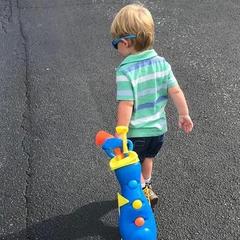
Ignore the older kid in this video (he's exaggerating things, so look if you'd like) and notice how this toddler runs and walks. He's doing so naturally, of course, because he's not been trained or worn shoes long enough to learn differently:
Check out how the foot works in this video of a guy running on a treadmill. Notice the foot stretch out, the toes curl up, the forefoot strikes first with the heel gently coming down as the foot is already moving backwards to power the runner forwards:
Compare those videos to this one, full of people over-striding because they've got big cushioned heels. Notice how the forefoot "slaps" violently against the ground and look at their legs, knees, etc. because I think you can literally see how much more force they're actually adding to their musculoskeletal system:
Okay, so that's enough science for now. What the heck does any of this have to do with golf?
It's simply this. I mentioned almost off-handedly to the CEO of TRUE Linkswear that I'd gotten into running and was going with shoes that are what's being called "minimalist" in design. Very little "heel drop" (the amount of extra padding in the heel versus the forefoot, 4mm or less as opposed to 12-20mm in some shoes), light weight, a bit less padding and cushioning overall. He responded by saying:
I'd written this in my TRUE Tour review:
If you can't tell from the images in this review, the toe box eschews the tapered, narrow style found in even the relatively comfy Adidas Tour 360 4.0's in favor of a rounder, wider, and more gentle shape. The TRUE Tour gives your toes room to wiggle a bit without being sloppy or squeezing the sides of your foot. If you've ever had a great pair of slippers, the TRUE Tours may give them a run for their money.
I've never worn a more comfortable pair of shoes. Over an 11-hour day, I didn't think about my feet or my shoes at all. I've got a pair of comfortable Skechers that I like to teach in, but the TRUE Tours blew them out of the water. My feet didn't just feel "okay" by the end of the day - they felt good. Slipper comfort that lasts all day? Yes please!
I wrote this in that post on running:
But the same holds true of walking in my opinion. Why train our feet - and by that I mean weaken our feet and subject them to more forces which can tire our feet, or cause soreness or injury - to walk in shoes that seek to take over the functions of our feet rather than working in concert with our feet?
Consider this. Why is the expression "as comfortable as a pair of slippers" so popular? Slippers don't have a lot of padding. They're not engineered like the modern running shoe. They don't have heels raised up in the air 10-20mm. They don't "control" our feet with supports in the arches and they don't bind our toes together with narrow toeboxes.
Tiger's been in the news for switching to the Nike Free golf shoes. Though they're not quite as "minimalist" as the TRUEs, they're much closer to that end of the spectrum than the traditional golf shoes.
And in the end, that's why I like TRUE shoes. I've always been barefooted more than most people, and when the CEO told me about their philosophy and inspiration, the two things connected.
I'll close with an image myself running barefooted and in a pair of TRUE Tours. My form isn't great, but I was running (jogging) as naturally as I could in both videos. I've stopped the first at the moment of impact.
Free your feet, people. Give your piggies some room to wiggle, start to use your feet as they've evolved to be used. Do so gradually - if you've been wearing structured shoes for a long time your feet may be weak and unable to accept a lot more work right away.
I think that if you consider all that I've said here and take steps towards reducing your footwear "technology," you'll be happier and enjoy walking more. Your feet will thank you. Study up on this stuff a little. And even if you don't want to change yourself, consider the shoes you buy for your children.
Some resources, many of which deal with running but which can still apply to any activity done with our feet:
Vibram Five Fingers has a great Getting Started Guide that walks you through a few exercises you can do to strengthen your feet, increase flexibility, etc. Whether you buy a pair of VFF or not, the guide is still good, so check it out even if you think VFFs are the ugliest thing since Courtney Love.
This page at TRUE Linkswear demonstrates a bit more of their feelings towards the "working with your feet" nature of their technology and shoes.
Harvard has some information and, while it's related to running barefooted, the same principles apply.
A nice article from WIRED that's a few years old. Some new research has been done since then, but it's still very good.
And finally, if you've made it this far and want to see a naked woman (seriously, plus a dude), click here for some interesting data from VFF.
http://www.runblogger.com/ , http://zero-drop.com/ , http://www.scienceofrunning.com/ , etc.