Jump to content
Check out the Spin Axis Podcast! ×
Note: This thread is 3800 days old. We appreciate that you found this thread instead of starting a new one, but if you plan to post here please make sure it's still relevant. If not, please start a new topic. Thank you!

Recommended Posts

Posted

I need more time to get my head around this. I can visualise the 2nd example starting left of target as the conditions are closer with -1° to +2° but -14° to +10°. Interesting.

Here's a visual ;).

Path goes way left, about 20 degrees.
Clubface is pointing about 5 degrees closed.
Ball starts pretty much where the face points.

Snead hit pull draws with a closed stance and not an over the top move.

Sam had a bit of an over the top move. Image on the left is just before the tend of the backswing. Hands are deeper and lower. Image on the right is just as he starts the downswing. Hands are more towards his head and higher. He swung to the inside, produced a slightly over the top move at the top. He compensated for that by aiming right and hit pull draws.

I'm suggesting they learn to swing on a consistent inclined plane for all shots.

All golfers swing on an incline plane of some sort. Most golfers swing too steeply. All golfers have a consistent swing. It's just bad golfers have a consistent bad swing versus a consistent good swing. Bad golfers are not bad because their swing changes a ton from swing to swing. The primary issue is that swing paths are so extreme the effective sweet spot on the club is very small and very small differences in face angles will produce great differences in shot shapes.

Matt Dougherty, P.E.
 fasdfa dfdsaf 

What's in My Bag
Driver; :pxg: 0311 Gen 5,  3-Wood: 
:titleist: 917h3 ,  Hybrid:  :titleist: 915 2-Hybrid,  Irons: Sub 70 TAIII Fordged
Wedges: :edel: (52, 56, 60),  Putter: :edel:,  Ball: :snell: MTB,  Shoe: :true_linkswear:,  Rangfinder: :leupold:
Bag: :ping:

Awards, Achievements, and Accolades

Posted

Here's a visual ;).

Path goes way left, about 20 degrees.

Clubface is pointing about 5 degrees closed.

Ball starts pretty much where the face points.

Sam had a bit of an over the top move. Image on the left is just before the tend of the backswing. Hands are deeper and lower. Image on the right is just as he starts the downswing. Hands are more towards his head and higher. He swung to the inside, produced a slightly over the top move at the top. He compensated for that by aiming right and hit pull draws.

All golfers swing on an incline plane of some sort. Most golfers swing too steeply. All golfers have a consistent swing. It's just bad golfers have a consistent bad swing versus a consistent good swing. Bad golfers are not bad because their swing changes a ton from swing to swing. The primary issue is that swing paths are so extreme the effective sweet spot on the club is very small and very small differences in face angles will produce great differences in shot shapes.


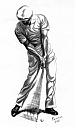
My instructor told me that most players shift their hands out from where they are at the top and that is not considered 'over the top'. He said when the shaft and club head get working over the top of the backswing plane that's when you get into trouble. Couldn't your hands shift outward in the swing without letting the club get steep? We've been looking at my swing on video and it turns out i'm in no way OTT. I actually drop my right shouder too far down when I start down which we now think is causing me to flip the club shut at the ball. This picture of Sam Snead's move is what we're actually trying to do...get my hands working more out instead of straight down.


Posted

My instructor told me that most players shift their hands out from where they are at the top and that is not considered 'over the top'.

This picture of Sam Snead's move is what we're actually trying to do...get my hands working more out instead of straight down.

I think it depends on a lot of things. Primarily where the clubhead is compared to where the hands and arms are at.

I think most good golfers get the clubhead to transition to a shallower plane in the downswing than a steeper one. Extreme case would be Ricky Fowler's old swing where he takes the club up and then it really gets flat.

I believe very few golfers have the Snead move where the hands loop up and towards the head. I think what saves him is the fact he then drops the hands down and doesn't continue that over the top path. So he kinda does a circle-ish loop move.

Matt Dougherty, P.E.
 fasdfa dfdsaf 

What's in My Bag
Driver; :pxg: 0311 Gen 5,  3-Wood: 
:titleist: 917h3 ,  Hybrid:  :titleist: 915 2-Hybrid,  Irons: Sub 70 TAIII Fordged
Wedges: :edel: (52, 56, 60),  Putter: :edel:,  Ball: :snell: MTB,  Shoe: :true_linkswear:,  Rangfinder: :leupold:
Bag: :ping:

Awards, Achievements, and Accolades

Posted

Sam had a bit of an over the top move.

OK but the real destroyer would be the OTT move where the shoulders rotate at the start of the downswing and Sneed definitely didn't do that.

All golfers swing on an incline plane of some sort. Most golfers swing too steeply. All golfers have a consistent swing. It's just bad golfers have a consistent bad swing versus a consistent good swing. Bad golfers are not bad because their swing changes a ton from swing to swing. The primary issue is that swing paths are so extreme the effective sweet spot on the club is very small and very small differences in face angles will produce great differences in shot shapes.

I agree.

I swing from in to in, in my mind anyway, and achieve this with something I call shoulder restriction. I'm sure there is a technical term for this but my feeling is that the right shoulder couldn't be more behind my right hip during the down swing. This just puts everything in sync for me and also helps me to maintain my back leaning spine angle during the down swing. Many of my fellow peers adopt the same down swing technique. I'd love to know if you have a technical term for this move on this board.


Posted
Another trick to try is instead of thinking of hitting the ball directly from behind, think of hitting the ball slightly on the inside.

Put the ball on the tee with the logo facing directly backwards, then rotate the ball a little so the logo is slightly on the inside towards you. Concentrate on hitting the logo, not the back of the ball.

I've been doing this for years and it really works for me. I use a sharpie to put an x on my ball. Then I just position the x,so that it's on the back inside quadrant of the ball. A lot of times the x gets transferred to my club face, proving that I hit the right spot. If I'm trying to hit a fade, I place the x on the rear outside quadrant.


Posted

If I'm trying to hit a fade, I place the x on the rear outside quadrant.

I've been doing this for years as well. I also put the x below the equator of the ball to allow for the loft of my driver face.

I don't understand the positioning the x on the outside quadrant. I realise you are visualising an out to in path but how can you hit that outer quadrant with an open club face?


Posted

I think it depends on a lot of things. Primarily where the clubhead is compared to where the hands and arms are at.

I think most good golfers get the clubhead to transition to a shallower plane in the downswing than a steeper one. Extreme case would be Ricky Fowler's old swing where he takes the club up and then it really gets flat.

I believe very few golfers have the Snead move where the hands loop up and towards the head. I think what saves him is the fact he then drops the hands down and doesn't continue that over the top path. So he kinda does a circle-ish loop move.


I'm not a good golfer and I apparently definitely shallow everything when my right side drops straight down. I'm no golf instructor but if you look at the pictures you posted it looks like the only reason his hands are higher is because his head drops and shoulders seem to get  steeper on his downswing. My instructor tells me that your hands work out and away when you start down but if the wrists are working right the club can still shallow or at least not get steeper. All I know is when I saw myself in slow motion video my head works higher and backwards and my hands and right shoulders seem to dip straight down. Is he looping or is it just a result of him squatting? Can't imagine anyone would call the great Snead a 'looper'?


Posted
I've been doing this for years as well. I also put the x below the equator of the ball to allow for the loft of my driver face. I don't understand the positioning the x on the outside quadrant. I realise you are visualising an out to in path but how can you hit that outer quadrant with an open club face?

Very easily. Your club face doesn't need to be open to the target. Just open to the path. If you are hitting a fade, your club face is almost always going to be closed (to target), not open. It's just that your path will be further left than your club face. The ball will start left, and fade back to the right.

Awards, Achievements, and Accolades

Posted

I'm not a good golfer and I apparently definitely shallow everything when my right side drops straight down. I'm no golf instructor but if you look at the pictures you posted it looks like the only reason his hands are higher is because his head drops and shoulders seem to get  steeper on his downswing. My instructor tells me that your hands work out and away when you start down but if the wrists are working right the club can still shallow or at least not get steeper. All I know is when I saw myself in slow motion video my head works higher and backwards and my hands and right shoulders seem to dip straight down. Is he looping or is it just a result of him squatting? Can't imagine anyone would call the great Snead a 'looper'?

His head does drop, but look at his hands compared to the tree line behind him. It's not an optical illusion. His hands do move up and over in an OTT move. It's slight, but not slight enough to where you can't see it.

Matt Dougherty, P.E.
 fasdfa dfdsaf 

What's in My Bag
Driver; :pxg: 0311 Gen 5,  3-Wood: 
:titleist: 917h3 ,  Hybrid:  :titleist: 915 2-Hybrid,  Irons: Sub 70 TAIII Fordged
Wedges: :edel: (52, 56, 60),  Putter: :edel:,  Ball: :snell: MTB,  Shoe: :true_linkswear:,  Rangfinder: :leupold:
Bag: :ping:

Awards, Achievements, and Accolades

  • Administrator
Posted

Snead hit pull draws with a closed stance and not an over the top move. Trevino, Couples, Lehman etc open stance. Rory closed and Jack open. I'm not suggesting that golfers should not shape shots or that they shouldn't adjust their feet alignment. I'm suggesting they learn to swing on a consistent inclined plane for all shots.

Rory's stance isn't closed. Lehman played draws and had an open stance as you've noted. Snead's pull-draws were obviously relative to his stance - he aimed right and pulled it (relative to his stance) and then it drew.

You can play push-draws, push-fades, pull-draws, pull-fades, or straight draws and straight fades and be a world class player. Alignment isn't super important.

I swing from in to in

Everyone does eventually.

Very easily. Your club face doesn't need to be open to the target. Just open to the path.

Where you impact the ball relative to the target line is purely a function of clubface angle, of course.

Erik J. Barzeski —  I knock a ball. It goes in a gopher hole. 🏌🏼‍♂️
Director of Instruction Golf Evolution • Owner, The Sand Trap .com • AuthorLowest Score Wins
Golf Digest "Best Young Teachers in America" 2016-17 & "Best in State" 2017-20 • WNY Section PGA Teacher of the Year 2019 :edel: :true_linkswear:

Check Out: New Topics | TST Blog | Golf Terms | Instructional Content | Analyzr | LSW | Instructional Droplets

Awards, Achievements, and Accolades

Posted

I've been focusing on having a more in to out swing.  I've been using the gate drill for the past week.  The majority of my shots end up being a push 5-15 yards to the right of my target.  If i focus on closing the club face will i develop a draw?

Driver: Cobra Fly Z Plus, Stock Stiff,  10.5
3 Wood: TaylorMade AeroBurner, Stock Stiff, 15.0
3 Hybrid: Nike Vapor Speed, Stock Stiff, 20.0
4 to GW: Mizuno JPX EZ, KBS Tour 120
54: Cleveland Tour Action, Standard Bounce
58: Nike VR Vx3x Grooves, Toe Sweep
Putter: Odyssey Versa
Grips: Golf Pride Tour Wrap 2G
Ball: Titleist NXT Tour

"Golf is not a game of good shots.  It's a game of bad shots." - Ben Hogan


  • Moderator
Posted

I've been focusing on having a more in to out swing.  I've been using the gate drill for the past week.  The majority of my shots end up being a push 5-15 yards to the right of my target.  If i focus on closing the club face will i develop a draw?

Are they straight pushes? Push cuts? Do the ones that start 5 yards right draw back?

Mike McLoughlin

Check out my friends on Evolvr!
Follow The Sand Trap on Twitter!  and on Facebook
Golf Terminology -  Analyzr  -  My FacebookTwitter and Instagram 

Awards, Achievements, and Accolades

Posted

Rory's stance isn't closed. Lehman played draws and had an open stance as you've noted. Snead's pull-draws were obviously relative to his stance - he aimed right and pulled it (relative to his stance) and then it drew.

You can play push-draws, push-fades, pull-draws, pull-fades, or straight draws and straight fades and be a world class player. Alignment isn't super important.

Everyone does eventually.

Where you impact the ball relative to the target line is purely a function of clubface angle, of course.

Maybe at your level, no. But for the rest, I firmly believe that alignment is basic for good golf.

:nike:

Awards, Achievements, and Accolades

Posted

Very easily. Your club face doesn't need to be open to the target. Just open to the path.

If you are hitting a fade, your club face is almost always going to be closed (to target), not open. It's just that your path will be further left than your club face. The ball will start left, and fade back to the right.

That's my point, if your club face is open to the path you can't possibly hit the outside quadrant. That can only be achieved if the club face is closed to the path. Target doesn't matter.


Posted

You can play push-draws, push-fades, pull-draws, pull-fades, or straight draws and straight fades and be a world class player. Alignment isn't super important.

I totally agree with the above statement. My point is that the game should be taught with square alignment and 3 flights. The push and pull shots should be explained as altered alignment. Lets face it, in general, our swing path is created by alignment.

Everyone does eventually.

Yes, in the process of swinging behind your body during the back swing and follow through then the path is always in to in at some point. The problem is at what point. With fairway shots it should happen after impact as the club hasn't reached the base of the arc and with driver, nearer to impact as the club should be passing the base of the arc. I almost don't understand this last statement myself. But I do understand the science and have a good visual in my head for this.


  • Administrator
Posted
Maybe at your level, no. But for the rest, I firmly believe that alignment is basic for good golf.

What I mean is that it doesn't totally dictate shot shape. [quote name="Bileyerheid" url="/t/13998/drills-to-make-swing-inside-out/60#post_1166764"] I totally agree with the above statement. My point is that the game should be taught with square alignment and 3 flights. The push and pull shots should be explained as altered alignment. Lets face it, in general, our swing path is created by alignment.[/quote] I disagree. I hit draws from an open stance. A TON of amateurs hit slices with a stance well right of target. Often stance helps influence path but sometimes in the opposite direction - more open makes them swing out more, for example. There are not three ball flights. There are nine. All nine (though rarely the "straight" ones) are used by PGA Tour players as their stock shot. Golfers need a PATTERN, but once they have that who cares if it's a straight draw or a push draw or a pull fade if they're hitting the ball toward the target? Once they get really good you tweak for launch conditions. But they need any of the nine as a pattern first. [quote name="Bileyerheid" url="/t/13998/drills-to-make-swing-inside-out/60#post_1166764"]Yes, in the process of swinging behind your body during the back swing and follow through then the path is always in to in at some point. The problem is at what point. With fairway shots it should happen after impact as the club hasn't reached the base of the arc and with driver, nearer to impact as the club should be passing the base of the arc. I almost don't understand this last statement myself. But I do understand the science and have a good visual in my head for this. [/quote] Nicklaus passed "that point" before he struck virtually every ball he hit from the fairway depending on how you define it. They point isn't low point, but it is when the path starts going back "in." Look you're just being too rigid and limiting. With a body alignment adjusted to 0, majors have been won by players with paths at low point (i.e. HSP or Swing Direction) of anywhere from about -10 to about +10. Again, that's relative to their alignment. Trevino swing out a bunch and hit baby cuts after all.

Erik J. Barzeski —  I knock a ball. It goes in a gopher hole. 🏌🏼‍♂️
Director of Instruction Golf Evolution • Owner, The Sand Trap .com • AuthorLowest Score Wins
Golf Digest "Best Young Teachers in America" 2016-17 & "Best in State" 2017-20 • WNY Section PGA Teacher of the Year 2019 :edel: :true_linkswear:

Check Out: New Topics | TST Blog | Golf Terms | Instructional Content | Analyzr | LSW | Instructional Droplets

Awards, Achievements, and Accolades

Posted

I totally agree with the above statement. My point is that the game should be taught with square alignment and 3 flights. The push and pull shots should be explained as altered alignment. Lets face it, in general, our swing path is created by alignment.

Nope.

I know guys who align closed and pull left, or align left and pull left. I know guys who do the opposite. Heck I played a year align left and pushing right.

Alignment has a very small influence on swing path. If you wanted to add a tad bit more curve, or take a bit of curve off then go ahead and adjust alignment, but you have to be aware of how your body reacts to that alignment.

I do agree that it's a good starting point to get someone to set up square. There are 9 ball flights, not three.

That's my point, if your club face is open to the path you can't possibly hit the outside quadrant. That can only be achieved if the club face is closed to the path. Target doesn't matter.

You could always shank it ;)

Maybe the only club you could hit the outside quadrant with an open face is the driver because the face is actually curved.

Hence this image. Magenta line is the target line. Green line is the path from the center of the clubface. The driver has some curve to the face because it is designed that way. Smaller circle is the impact point, which is in the outside quadrant for a path going to the inside. The clubface is 5 degrees open ;)

Matt Dougherty, P.E.
 fasdfa dfdsaf 

What's in My Bag
Driver; :pxg: 0311 Gen 5,  3-Wood: 
:titleist: 917h3 ,  Hybrid:  :titleist: 915 2-Hybrid,  Irons: Sub 70 TAIII Fordged
Wedges: :edel: (52, 56, 60),  Putter: :edel:,  Ball: :snell: MTB,  Shoe: :true_linkswear:,  Rangfinder: :leupold:
Bag: :ping:

Awards, Achievements, and Accolades

Posted
Stuck in the weeds - drills for in to out were to do what? :-(
Awards, Achievements, and Accolades

Note: This thread is 3800 days old. We appreciate that you found this thread instead of starting a new one, but if you plan to post here please make sure it's still relevant. If not, please start a new topic. Thank you!

Create an account or sign in to comment

You need to be a member in order to leave a comment

Create an account

Sign up for a new account in our community. It's easy!

Register a new account

Sign in

Already have an account? Sign in here.

Sign In Now


  • Want to join this community?

    We'd love to have you!

    Sign Up
  • TST Partners

    PlayBetter
    Golfer's Journal
    ShotScope
    The Stack System
    FitForGolf
    FlightScope Mevo
    Direct: Mevo, Mevo+, and Pro Package.

    Coupon Codes (save 10-20%): "IACAS" for Mevo/Stack/FitForGolf, "IACASPLUS" for Mevo+/Pro Package, and "THESANDTRAP" for ShotScope. 15% off TourStriker (no code).
  • Popular Now

  • Posts

    • Wordle 1,631 3/6 🟨⬜🟨🟨⬜ 🟨⬜🟨🟩⬜ 🟩🟩🟩🟩🟩
    • Wordle 1,631 3/6 ⬜🟩🟩🟩⬜ ⬜⬜⬜⬜🟩 🟩🟩🟩🟩🟩
    • Wordle 1,631 3/6 🟨⬜🟨🟨⬜ 🟨🟩🟩⬜🟩 🟩🟩🟩🟩🟩
    • Is it? I bought the Stack radar to replace my PRGR based on what Stack told me! When I am swinging for speed, the PRGR would miss 50%-80% of my backswings due to a higher speed. The stack seldom misses those- at least for me.
    • As an analyst by nature, I would like to compare the scores under both systems. It is something we can easily do if we have the data. I actually thought the new system was less fair to those whose game was on the decline - like mine! Old: Best 10 of last 20 scores with the .96 multiplier. Course handicap excluded course rating and overall par. New: Best 8/20. Course handicap includes course rating -par. My understanding is Stableford caps scores at Net double bogey like stroke play. If so, handicap should be slower to rise because you are only using 8 versus 10 scores. If I am missing something, I am curious enough to  want to understand what that may be. My home course tees that I play are 72.1/154 now. My best score out here is 82. When my game started to decline, my handicap didn’t budge for 13 rounds because of good scores in my first 8! I know I am an anomaly but my handicap has increased almost 80% in the past few years (with only a few rounds this year). For a few months I knew I was losing every bet because my game was nowhere near my handicap. I suspect I have steamrolled a few nuances but that shouldn’t matter much. When I have modeled this with someone playing the same tees and course, one good round, or return to form, will immediately reduce the handicap by some amount.
×
×
  • Create New...

Important Information

Welcome to TST! Signing up is free, and you'll see fewer ads and can talk with fellow golf enthusiasts! By using TST, you agree to our Terms of Use, our Privacy Policy, and our Guidelines.