Jump to content
Check out the Spin Axis Podcast! ×
  • entries
    57
  • comments
    772
  • views
    53,212

The Wall Drill for a Proper Pivot


Here's a student many will tell you "lacks flexibility." He thinks it (sometimes, when I haven't seen him in awhile :-D), other instructors have told him he lacks flexibility, etc.

His hips sway right, his torso turns about 75°, and he lifts his arms up to "finish his backswing."
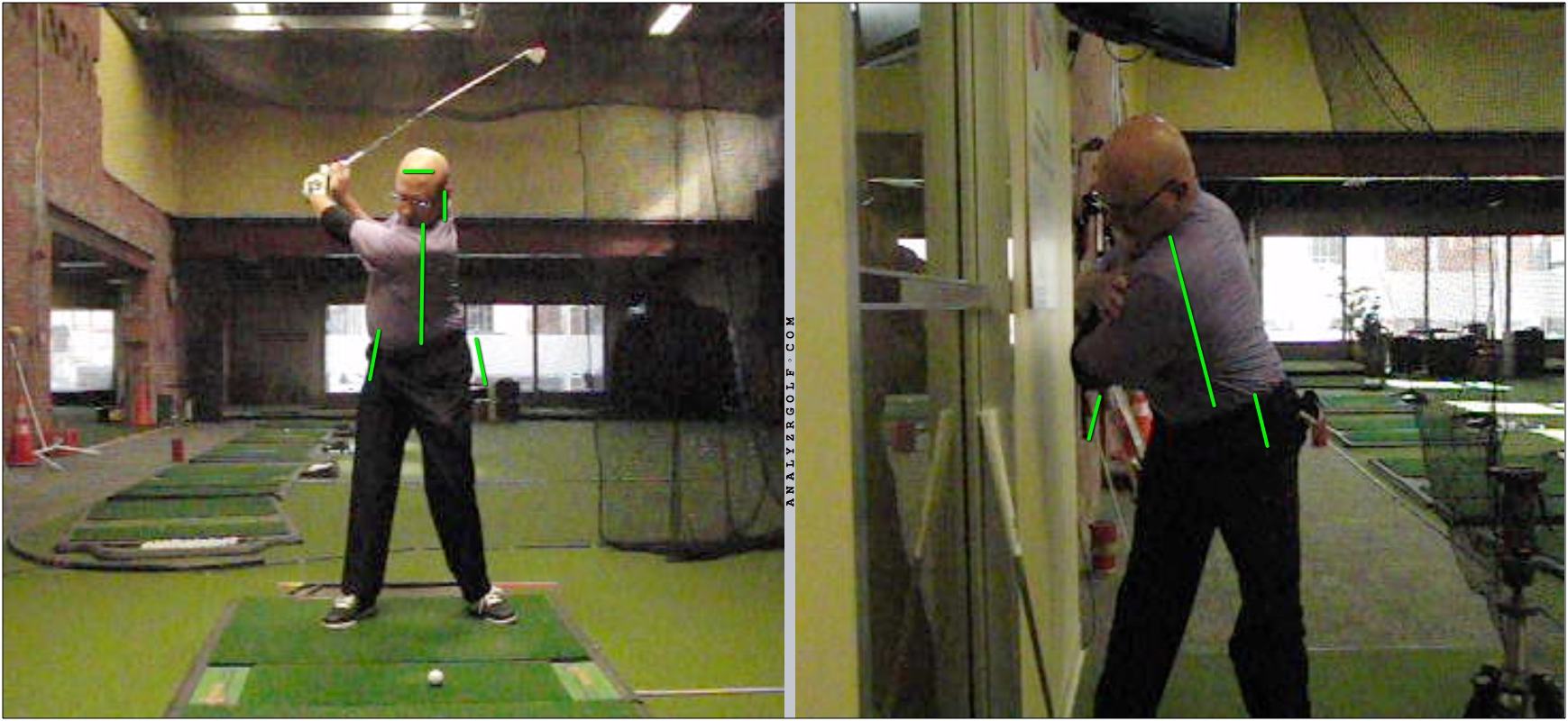
563d2e87581ed_01Wall.thumb.jpg.bc9365191

It's a bit better in the left photo here because he's been working on this for quite some time now, but even still you can see those trademark things: hips sway back, no secondary tilt, head rises, arms lift, turn isn't great.

On the right you can see him doing the wall drill. You set up near a wall. You note how much space you have between your trail hip and the wall, and then you put your arms across your chest and make a backswing while you strive to increase that distance. Make the gap between your trail hip and the wall get bigger. Voilà! Secondary Axis Tilt, hips going forward during the backswing (yes, a bit too much, but this is a drill, exercise, or "feel"), head not going up, more torso turn.

The proof, as they say, is in the pudding.
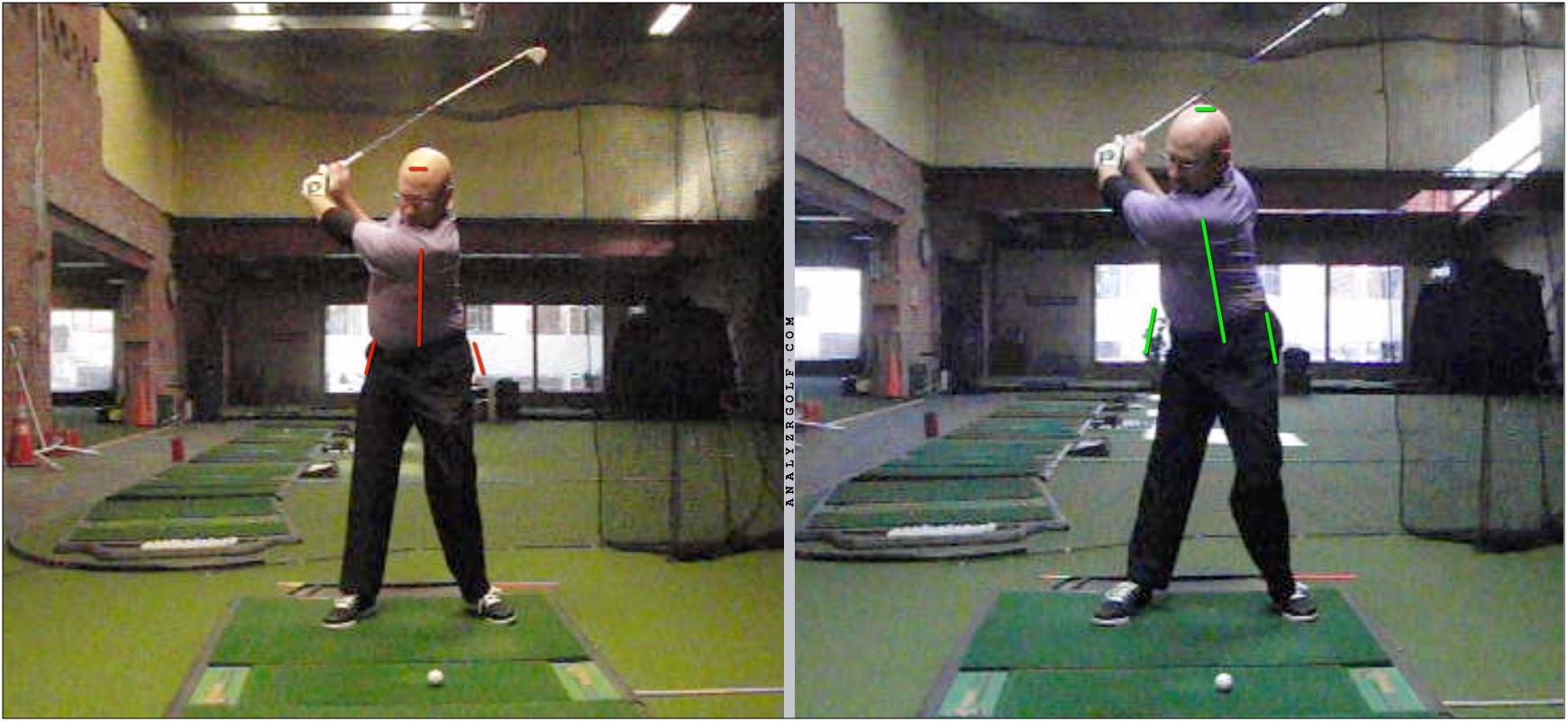
563d2e8a2318b_02SLOWDOWNDUMMY.thumb.jpg.

It's important to note that you don't necessarily actually want all of these to occur during your backswing. This drill reverses a lot of what you do (hips swaying instead of turning, moving too far right instead of staying "centered", reverse axis tilt). It's a great drill for an 18 handicapper who sways and wants to get better now.

As always, these are actual swings, not posed shots.


2017-09-15: Edited the title. Originally it was "Lack of Flexibility and the Wall Drill". We teach this to people who DON'T think they lack flexibility, too. Even kids.

2021-11-25: There are some updated thoughts here that I encourage everyone to read.

  • Like 5
  • Thumbs Up 1
  • Upvote 11
  • Informative 1

17 Comments


Recommended Comments

  • Moderator
mvmac

Posted

This post deserves MUCHO reputation points!

  • Upvote 1
kpaulhus

Posted

I need to work on this. I do not turn my hips enough. Also, I was recently asked why I was straightening out my right knee instead of keeping it flexed. What are your thoughts on that? It almost feels like I'm squatting a bit in my backswing, and I doubt my head is staying still, though I haven't recorded it yet. 

  • Administrator
iacas

Posted

6 hours ago, kpaulhus said:

I need to work on this. I do not turn my hips enough. Also, I was recently asked why I was straightening out my right knee instead of keeping it flexed. What are your thoughts on that? It almost feels like I'm squatting a bit in my backswing, and I doubt my head is staying still, though I haven't recorded it yet. 

Your trail knee should probably extend on the backswing.  I'm not sure what you mean by that. Should it "straighten" (i.e. lock out)? No. Should it extend? Almost surely, yes.

Sometimes it can feel like a little squat, but you don't want your head to go down and back much.

kpaulhus

Posted

Thanks for that link to Mike's post. Ill read through that today since Im hitting the range over lunch. 

AbsoluteTruths

Posted

You need to check your weight/pressure when doing this drill. I was swaying back and rolling to the outside of my right foot. Need to keep pressure on the inside of right foot.

  • Upvote 1
isukgolf

Posted

OK I tried it ... I am sold ...

Guest S n T backswing

Posted

Left hip should be lower then the right in back swing

Mike Boatright

Posted

Im always looking to turn better and I can see in by back swing that my weight goes to the outside of my back foot. I have it timed so I don't know if it's good or bad but I know it causes inconsistency.

sirhacksalot

Posted

So finally tried this while hitting balls in the net and it greatly improved strike, unfortunately the feel is that its going to cause big blocks to the right. So need to try on range or course to see what it flght will do.  

k-troop

Posted

I've always tried to emphasize a full shoulder and hip turn away from the ball, and I think it definitely helps prevent me from swinging too far left across the line at impact (which has always been a problem area for me).  Interestingly enough, I had a dozen sessions with a physical therapist this year because of some pain at the intersection between my T and C vertebrae.  PT did range of motion tests at the beginning, middle, and end of the course of the evaluation/therapy.  My shoulder and hip rotational range is significantly more turning to my right (backswing motion) than it is in the opposite direction.  My backswing range of motion was (according to the PT) very good, but my follow-through range of motion was "restricted." 

I told him it doesn't matter at that point because the ball is already in the air.  He disagreed.  My neck still hurts, so what does he know?

Kalnoky

Posted

I was just doing these wall drills in the conference room. I like it. 

Ready for 5 o'clock

Golfdad2014

Posted

On 2/3/2017 at 1:03 PM, k-troop said:

I've always tried to emphasize a full shoulder and hip turn away from the ball, and I think it definitely helps prevent me from swinging too far left across the line at impact (which has always been a problem area for me).  Interestingly enough, I had a dozen sessions with a physical therapist this year because of some pain at the intersection between my T and C vertebrae.  PT did range of motion tests at the beginning, middle, and end of the course of the evaluation/therapy.  My shoulder and hip rotational range is significantly more turning to my right (backswing motion) than it is in the opposite direction.  My backswing range of motion was (according to the PT) very good, but my follow-through range of motion was "restricted." 

I told him it doesn't matter at that point because the ball is already in the air.  He disagreed.  My neck still hurts, so what does he know?

My wife is a PT and have to get her to manipulate my back after every range session. The area you are talking about is a very common problem with golfers backs. 

PT's have a doctorate of therapy for a reason. They are very well trained. Find a therapist that is manual or McKenzie certified. They should be able to help you get right. 

k-troop

Posted

13 minutes ago, Golfdad2014 said:

My wife is a PT and have to get her to manipulate my back after every range session. The area you are talking about is a very common problem with golfers backs. 

PT's have a doctorate of therapy for a reason. They are very well trained. Find a therapist that is manual or McKenzie certified. They should be able to help you get right. 

Good advice, and thanks for the tip.  I completed the full course of the "evaluation" period, which included initial eval and range of motion, 8 sessions of manipulation (with stretching and exercises in between), and an ending eval.  The manipulation sessions definitely felt good, but did not really affect my issue at all.  PT's conclusion was that the treatment wasn't effective.

Antneye

Posted

I did a search for wall drill and landed here but I could have sworn there was a wall drill thread to combat your head moving forward and down towards the ball.  This is something that I have been working on for over a year and cannot eliminate from my swing even with repeatedly doing this exact drill (only with my head starting about a quarter inch away from the wall).  I can do it just fine with my arms across my shoulders (my head never hits the wall as i come through my turn to the finish). but a golf club in my hand and I am still darting down and towards the ball (although not nearly as bad as seen in my first swing thread post)

Is there any other drill out there to help eliminate my head going forward?

  • Administrator
iacas

Posted

3 hours ago, Antneye said:

Is there any other drill out there to help eliminate my head going forward?

Put a stick beside your head (front side) and try to move your head away from it on the downswing?

Create an account or sign in to comment

You need to be a member in order to leave a comment

Create an account

Sign up for a new account in our community. It's easy!

Register a new account

Sign in

Already have an account? Sign in here.

Sign In Now


  • Want to join this community?

    We'd love to have you!

    Sign Up
  • Blog Entries

  • Posts

    • Haiduk - Archdevil        
    • Probably since the golfer has to swing the club back and up. The hands have to move back and up. You can feel them go back and up just by turning the shoulders and bending the right arm, because it brings your hands towards your right shoulder.  The difference is if you maintain width or not. Less width means a shorter feeling swing path so the more you need to lift the arms. Being as someone who gets the right arm bend at 110+ degrees, it's 100% a timing issue. I am use to like a 1.5+ second backswing. It probably should be like 1 second at most. Half a second or more will feel like an eternity. I have had swings where I keep my right arm straighter and I am still trying to time the downswing based on the old tempo.  Ideally, for me, it is probably going to be a much quicker and shorter (in duration) backswing, while keeping the right elbow straighter. Which also means more hinging to get swing length without over swinging. 
    • Wordle 1,789 5/6 ⬜⬜⬜⬜⬜ ⬜⬜🟨⬜⬜ ⬜🟩⬜🟩🟩 ⬜🟩🟨🟩🟩 🟩🟩🟩🟩🟩
    • I'm currently recuperating from surgery, so no golf, but have been thinking about this quite a bit. This and the don't overbend the right arm thing. It's hard for me to even pose the position, so I'm not 100% sure, but I feel like it's impossible to have the right humerus along the shirt seam and not overbend your right arm, unless your hands are down near your hips. If the left arm is up at or above the shoulder plane and your right arm is bent less than 90 degrees, then your right humerus has to raise or your hands will get pulled apart. Your left hand can't reach your right hand unless either the right upper arm is up or the right arm is overbent. Is that right? If it is, then focusing on not overbending the right arm would force you to raise the humerus. And actually thinking further on it, if you do overbend your right arm, then you're basically forcing your upper arm down or forcing your left arm to bend. Since (for me at least) bending the left arm too much is not something I think I need to worry about, it means that the bend in the trail arm is really the driving force behind what happens to the right humerus. 
    • I managed to knock off a 3, a 13, and a 15 a couple of weeks ago. The 3 was a 185 yard par 3 with a 6 iron to 12 feet. 13 was a 350 yard par 4, which was a 2 iron and a 9 iron to about a foot. 15 was a 560 yard par 5 with a driver in a bunker, 4 iron into the semi, gap wedge to 8 feet and a putt.
×
×
  • Create New...

Important Information

Welcome to TST! Signing up is free, and you'll see fewer ads and can talk with fellow golf enthusiasts! By using TST, you agree to our Terms of Use, our Privacy Policy, and our Guidelines.