Blogs
Our community blogs
-

- 11
entries - 82
comments - 5503
views
Recent Entries
 Latest Entry
Recognizing Blessings
It may have been a cold gray day yesterday afternoon, but I enjoyed my nine holes very much.
The quick tour of the front nine with Ralph and Bob sure beats the hell out of watching my beleaguered fantasy football teams, but Sunday was just a bit better than usual. My driver finally cooperated. The normally recalcitrant 1W hit five fairways and narrowly missed a sixth with legitimately solid 250-yard drives. Have no idea where that's been all year, but better late than never. I finished with a 42. Maybe not conventionally impressive but about as well as I've done all year for nine holes.
The pleasantness of the round and the steadily approaching end of the season, got me reflective.
Covid, crowds, closures and crappy golf were so much a part of the spring and early summer. Losing KIttyhawk was hard. Particularly for an introvert like me, the place was the one social outlet I really had. No matter what time, one of Kittyhawk's courses would be available. The range was huge. Sometimes, I'd come just to chip and putt on one of the three big practice greens. The slate of events my old association had for us meant that a hacker like me could always compete in events with people like me and I got to know a lot of those guys. Those are all things that can't be replaced.
None-the-less, I'm thankful for how things eventually turned out.
Mostly, I'm thankful my new friend Ralph was willing to let me join him for his 2 p.m. tee times. Through him I met several other club members and made the business of securing tee times possible on a course that was jam-packed most of the season. Getting to know these guys over the season has been enjoyable enough to take the sting out my struggles hitting the ball.
I'm also very pleased to be a member at a course like Miami Shores where the City of Troy is actually investing in the facilities instead of closing them. Course conditions there had always been fairly decent. To that the city recently added a new driving range and new clubhouse. The range has been so successful that they are building an additional tee area at the far side of the property. Enough were using it that we kept running out of turf. The pro, Kyler Booher, and his staff do an excellent job.
I think I'll try to ramp back up with the handicap next year. Maybe if I get back to some level of decency we'll even give the Club Championship another try.
Either way, I've got a home course to do it at.
- 11
-

 Latest Entry
Ruminations Part 2
Day two of the four day tournament. Sunday, April 21, 2024.
As luck would have it, my fellow competitor and cart partner during the qualifier was the 3rd seed, so we would play against each other in the first round. He is a very nice guy and we got along very well. I think that made it easier for both of us to play. It was his first tournament, and he was nervous, but he told me I helped him a lot by explaining rules and keeping the mood light by being the general assclown that I am. And that helped me, too. I didn’t really think about playing golf except for the brief moments I had to, which I devoted my full attention to. He did rake a putt in the qualifier round, but even with that penalty stroke he managed to shoot net 71. I covered our match briefly in the member tournament thread.
My warmup for the day went terribly. I was struggling to hit the ball well on the range at all. It was kind of uncomfortable walking off the range feeling like I didn't know how to swing a golf club. There was nothing I could do about it, so I moved onto the putting green and did my usual thing there.
Trading Blows
I surprised myself with how well I played, especially when I really needed to. He was getting five strokes from me. I hooked my 4i off the first tee and made double, down 1 right from the start. Followed that with a much better 4i off the tee and won #2 with par. On #3 we both missed the green and he pitched it inside of 2', which I gave him. I almost holed my chip and we halved. The 4th was the first par 5 of the day which I won with a 3-putt par. We had matching bogeys on #5 which he won because he got a stroke, then he won #6 with par. The tees were way up and the hole played under 100 yards. I had a little bit of fun on this hole and decided to hit a low runner type of shot which wasn't a bad idea and I actually hit it pretty well, but it just caught the ridge and rolled off the back. I think if I had to do it over I'd still hit the same shot, just more to the right.
Tees were up again on #7 (I think they were having a little bit of fun setting up for the tournament). The pin was front left and I smoked my 4w. One of the other guys in the group asked if we should yell fore for the guys putting on the green. I said no, I'm well right of them. And it turned out I hit the green, but I was also 30 yards right of them so I felt like I was right in not having to yell fore, but maybe that's close enough to warrant it? I still don't know how I feel about it, honestly. I didn't yell fore, nobody got hurt, and nobody seemed mad at me about it, so I think I'm ok. I 2-putted for birdie and won the hole. I pushed my drive on the tough par 4 #8 but found the fairway bunker and hit a great shot out of it just past pin high left of the green. Faced with a hole cut on a hump and everything sloping away from me, I decided to putt my ball out of the rough and I almost holed it. Made par. He made a mental error here as he lagged his 4th shot inside of 2' and I asked him what he was putting for, since he was getting a stroke on the hole. He started to count his strokes, then kind of just haphazardly tried to hole the putt in the middle of counting because he was standing astride someone's line before he gave me an answer and missed it. I felt kind of bad about it because I had asked with the intention of possibly conceding the putt. #9 is the mistake I mentioned in the other topic where I put my second shot in the water trying to go for the green in two, knowing I was giving up a stroke and he had already hit two good shots. He made net birdie anyway and we were AS after trading eight of the first nine holes.
Stick to the Plan
We played Lake for the back 9. It was the course I hadn't played in the two rounds at Neshanic this year so far, so I tried my best to take my game plan and apply it on the fly. We both made par on #10. On #11 I thinned the crap out of my 4i and it didn't clear the ESA. Teed it up again and hit it right where I wanted to hit it the first time (more experience). He didn't hit his tee shot well and then had some trouble hitting out of the rough a couple of times. I realized I wasn't dead on the hole and hit my 110 yard approach inside of 10' and two putted. We halved. On #12, a par 3, I hit a bird. Literally. At least I think I did. I watched the ball come down and disappear behind the mound where it should have hit the green and rolled to the left, instead it took a hard crazy sideways bounce right just as a bird flew off in the opposite direction. There isn't a sprinkler head there or anything. Maybe it didn't hit the bird because I probably would have killed it, but it was a weird bounce all the same. We both made 4. On #13 I smoke my drive and had about 110 left to the pin, accidentally hit the ball out of the sweet spot on my approach and ended up 60' past it. Then I putted that one to tap-in distance. He made net par to halve.
#14 is where his troubles began. I wrote about this hole in the other topic, too. He hooked his drive into the pond and I hit a pretty good drive just left into the rough/fescue. I hit my second into the left fairway bunker and spent some time helping one of the other players in the group look for his ball in the fescue. We found it and he asked me if I knew the yardage from where we were. I looked at my H4 and it had given me the yardage to the next hole, presumably because I had crossed over to it at some point during our search. I switched it back and gave him the number - it was like 150ish. After he hit his shot, I went to my ball farther up and in the bunker. For whatever reason, I didn't use my rangefinder and only briefly glanced at my H4, which gave me a yardage of 150ish. It didn't occur to me at the time that it couldn't have been that number. I don't know if it was the GPS lagging because it was overcast, or it was on the wrong hole, or I simply read it wrong. I pulled a club and hit what I thought was a great shot out of the fairway bunker based on the contact, only to watch it fly the green by a lot. This would not be the last time I pulled the wrong club during this tournament. I almost lost the ball, but fortunately the 4th member of our group found it in the deep stuff. I managed to gather myself and hit a decent shot just onto the green and two putt for bogey to win the hole.
#15 is a simple, short, dogleg right par 4. They removed the pot bunkers hidden behind the hill in the fescue which makes it much more inviting to just hit driver over everything and leave a 50 yard shot into the green. I stuck to the plan and smoked a 6i to the corner in the middle of the fairway. My opponent hit a decent drive past my ball. I pulled my approach shot and hit the green but had about 50' to the hole and he thinned his over the back. He flubbed his chip and was over 30' away and I hit another long putt to tap-in distance and won the hole. #16 is another short dogleg par 4 with water all along the right that was playing up again. I briefly flirted with the idea of going more aggressive but went with 7i off the tee. Neither of us hit good shots and we both ended up in one of the fairway bunkers on the left. I had an 80 yard bunker shot with water to the right and behind the green. I kind of just went with my gut and hit a half swing PW 8' short of the hole. He struggled on the hole, just getting it out of the bunker on his second and I don't remember exactly what he did on his third because as he put it, my bunker shot was "the nail in the coffin." I two-putted to win the match 3&2.
I Can Breathe Again
I breathed a sigh of relief that it was over and then I pulled my tee shot on the par 3 17th into the weeds. The other match was still going on so I told them not to worry about what I was doing, to do their thing and I'll just find my ball and pick it up. I didn't find my ball. We got to #18, Lake #9 which is my favorite hole on the whole course. Not because it is easy, but because it is hard. I hooked it OB off the tee and decided I was done playing golf for the day. Apparently I had reached my limit of focus for golf for the day, or perhaps I really just let it all go once I relaxed, but I knew after hitting two straight misses I hadn't hit all day that I was not capable of playing any more golf. There was another match going on in our group, after all, and I did not want to be a distraction.
My opponent hit what he described as the best hybrid he'd ever hit on #17 to 6' and made par. He followed that up with a well played par net birdie on #18. Apparently the pressure of the match being gone had the opposite effect on him.
- Read more...
-
- 0 comments
-
- 3
entries - 28
comments - 5218
views
Recent Entries
 Latest Entry
Nothing to play for
There have been 2 or 3 threads lately of guys that are getting burnt out on golf, or don't know why they are still playing.
I cant say I am at that point, as I still average over 120 rounds a year. I guess with my hype of getting ready for the US Mid Am and my Club Championship this year, I've been so focused on the goal. Well, now that those have past, I am simply playing to play. Have some fun. You never know what "winter" will be like in Arkansas. Last year we had 1 day where there was a very light snow that melted the next day, so golf improvements over the winter were pretty possible. The year before last we had 4 or 5 days were the area shut down since there are no snow plows to clear the 4-5 inches we got. It was damn cold for a long time.
Ill continue to keep up with evlovr monthly hoping to come out in the spring ready to fire some great scores. The good news is, the best time of year is starting. Cooler temps & thinner rough are fast approaching. No more helping people search for balls in the rough on every hole, and literally grip it and rip it without much worry of missing the fairway. Fall golf is great. Setting my sights on 2017 and overall improvement. Very proud of the 2016 season, but ready to turn the page on this chapter in golf.
- 3
-
Latest Entry
Welcome to the Jungle
I wanted to put together a series of golf tips and strategies to help the Average Joe better enjoy this crazy game we all love. A large part of this blog is going to be short tips like "How to Get Rid of Shanks" or "Stop Picking Your Head Up," but occasionally I will write some longer articles as well.
So to kick off this series, here's a tip that helps keep your score down that even I sometimes forget: don't take penalties. Generally speaking, penalties are strokes that inflate your score without helping you score any better. I know it may seem tempting to hit a big drive OOB and get another shot at it, but you're almost always better off just hitting a good shot the first time. The same goes for water hazards - stay out of them, no matter how dirty your ball may have gotten over the course of a round. Chances are, you're not going to be able to retrieve your newly washed ball anyway. Save yourself some extra strokes and wash your ball at the ball washer which many courses have at the tee box. Your scorecard and your wallet with thank you later.
That's my first tip, hopefully of many. Any comments or questions, please leave them below. And if you liked this post, please give it a thumbs up and subscribe.
- Read more...
-
- 0 comments
-
 Latest Entry
Golf Telecasts - Sensational or Stupid?
We learned this week that the Fox Network has severed ties with Greg Norman, who served as the network's lead analyst for their broadcast of the 2015 US Open. This news prompted me to think about golf broadcasting and sports broadcasting in general. I think it is time for a change. But before we get to that, I think it's a good idea to look at how much better sports and golf broadcasting is today, compared to how it was just a few short decades ago.
I grew up watching sports in the 1970s. Things were clearly different then. Some of the biggest differences between now and then are attributable to technology. There are more cameras now, so we see the action from many more vantage points than ever before, in all sports. The cameras are better...meaning we see clearer, sharper images, both in real time and in slow motion. Sound is much better. And of course the delivery system and the end-user view are radically changed; anyone who remembers adjusting an antenna or the "tuning" knob on and old TV knows that we are now spoiled with what are, in general, universally good, sharp, interference-free views of sporting events. The icing on the cake had to be large screen televisions, with sharp, colorful displays that we could only dream about when watching Jim McKay on "Wide World of Sports" or Keith Jackson do a college football game.
Golf broadcasts today are a visual treat. In the 1970s and 80s, and even to a degree in the 1990s, there were far fewer cameras covering the action. We can see action on all 18 holes, and mobile cameras give us close up shots of the lie of the ball, the golfer's perspective, his or her reactions to the shot, etc. Even the camera angles are better: at one time, the target-facing cameraman seemed to always position himself somewhat off to the side of the player, so that every shot looked like it was going dead right. Graphics are better, particularly overhead shots and flyovers where stats about the hole are given, lines are drawn indicating carry distances, etc. And let's not forget shot tracer, a technology that seems universally loved and adds an exciting element to watching a shot in real time.
Yet with all of these improvements, we still hear many, many complaints about golf broadcasting. Many of the complaints are sort of universal complaints that people might have about any live event coverage, i.e., too much advertising time, [insert announcer's name] has an irritating voice, or is stupid, etc. Here is a critique of CBS's coverage of the 2016 Honda Classic, replete with a laundry list of complaints big and small, many of them quite compelling. While it would be impossible to make everyone happy with respect to these sorts of complaints, I think there are ways in which golf coverage could be improved.
I think the main problem with golf broadcasting on the major US networks is simply that they talk and analyze too much. It is just the natural culmination of years of "improvements," such as more cameras, more on-course reporters, more tower commentators, more sound, etc. There is a point beyond which any pleasant thing starts to lose its appeal, or even become unpleasant. Like that 20th cigarette your Mom made you smoke when she discovered the pack in your pocket, or the 4th piece of pie you ate on Thanksgiving Day.
They simply talk too much. For any given shot, we might have non-stop talking, beginning with Johnny Miller or Jim Nantz in the 18th tower, to Koch's or Maltby's description of the lie, to a question by Miller about some aspect of the shot, to Maltby's answer, to the filling in of other information (club selection), to the conversation between player and caddie, continuing after the shot to an in-air description of the trajectory, followed by commentary and analysis of the result.
This happens over and over and over, and to me, it's lost it's appeal. In fact, I'm sick of it.
There are so many people, so many voices, that between the shot coverage, the comments on the players' personalities or outside lives, discussions of their swings, witticisms from the various court jesters (Feherty, McCord), the broadcast is a virtual verbal assault with almost no breathing room. They seem to enjoy hearing each other talk.
European Tour broadcasts - perhaps because of a more limited budget - are much more Spartan. An entire shot might be taken without any commentary whatsoever, except for maybe "he'll have that for par to remain on 7 under." The experience is refreshing.
To be clear, I'm not "venting" a dislike for any individual announcer (although I could...there are many who drive me crazy). I think that the overall broadcast formula has evolved into something which detracts from the viewing experience.
Part of the fun of watching sports is the excitement, not knowing what will happen next. When I watch sports, I'm always wondering to myself, what is the player thinking, what is he trying to do, what might he be coping with in this situation? To do this in silence as you watch can make the experience richer, more dramatic. When someone other than the player is constantly talking about these things, it takes your focus off the player, and your own, unique reaction to the experience.
Sometimes, less is more. It's true in so many areas of life. They need to understand this when they cover golf. It's ok not to talk. It's ok not to analyze a result. We don't need to hear why the shot went off poorly, or that you think it was the greatest shot you've ever seen. While all of these comments have their place and can have entertainment value, their extreme overuse has robbed them of almost any impact whatsoever.
Take the experience of an important putt. Typically, there is the "what's he got Roger, left edge? Yeah Johnny, I'd say it's inside left if anything, not much there. Yeah Roger but he needs to hit this because it's into the grain...." followed by "this is on a really good line.....!!!" etc. For me, it would be far more dramatic to cut to the putt as the player is in the last few seconds of his preparation, and have the announcer say "from 22 feet, for birdie to take the lead." Then, simply watch and listen. A good camera angle can add much the drama. And the latter is important, too: Great quality sound, catching as much of the gallery reaction, as the putt approaches the hole, as possible.
Some will say "then why don't you just mute your TV....I like the broadcasts the way they are." Fair enough...there is a workaround. But not really. Nobody wants silent broadcasts. Announcers and analysts are important. The issue is that I think the directors are placing too high a value on analysis, and are overusing it to the point of distraction.
To me, the modern golf viewer experience has been spoiled in a fashion similar to how I believe smartphones have spoiled experiences like graduations, childrens' plays and recitals, etc. Being able to record something on a smartphone is a powerful, seductive thing, and few of us can resist it. Yet, when doing it, I find myself coming away feeling as if I missed actually experiencing and feeling the event, because I was distracted by my role as filmmaker. Similarly, when we watch golf, our attention to the shots and the drama of the tournament is diluted by the talking, the analysis, and the descriptions. Yes, we need some descriptions, and yes, the broadcasts would become very boring if all they did was describe results. But I think a significant amount of this chatter could be eliminated and it would improve the experience tremendously.
I hope the TV networks will be willing to take a fresh look at their methods. It's not just a matter of finding the right person for the tower or a clever or funny on course commentator. It's about the golf, and the best way to deliver it to the viewer. I think they have some work to do and much room for improvement. What do you think?
-
 Latest Entry
The Day Golf Became Easier
Every golfer has the thought at some point..
"If only I could consistently shoot in the 70s, then I would enjoy golf more."
We get lost in our heads, dreaming of a fantasy where golf was one day an easy game.
What if we didn't have to worry about water hazards, sand, or OB?
What if 3-footers didn't bring us anxiety?
What if we could enjoy that pure strike that we long for on every single shot?
I'd argue that the better a golfer gets, the more enjoyable the game is.
But.. not in the way that most golfers imagine.
In this post, I will be examining our love affair with golf, how we can enjoy the failures that the game inevitably brings us, and why golf will never get easier (but can become more enjoyable).
Why Do We Love Golf?
What is fun about slicing a golf ball into the window of a house, or duffing a chip into the bunker?
If you're a bit more experienced, what is fun about making a triple bogey on the last hole to shoot 82?
Even at the highest levels, what is fun about missing a 5 footer to make the cut in a big tournament?
Golf is a game of heartbreak. For every great shot, there are five bad shots. You will fail by most standards 99% of the time. You might spend hours on the driving range, and perform worse the next day. If you hit one shot in the wrong place, your entire round could turn for the worse.
So why?? Someone explain to me why we love this game so much??
From another perspective, it does feel amazing to hit a pitch shot off tight turf, watch it bounce short of the hole, spin, and stop an inch from the cup.
It also feels rather pleasing to hit a low stinger down the middle of the fairway on a tight par 4.
Heck, it even feels great to make that dead straight 3-footer on the last hole to shoot 72!
In reality, our love affair with golf comes from something completely out of our control.
In pyschology, this external force is called "operant conditioning."
More specifically, as we practice golf, our behavior is being reinforced on a "variable-ratio" schedule of reinforcement. In psychological terms, this means that our behavior (hitting another golf ball) is reinforced after an unpredictable amount of responses (you never know when that "pure" strike is going to come). This reinforcement schedule is often noted as producing a high and steady rate of response (why you can't get yourself to stop hitting golf balls).
What you might not realize is that this type of operant conditioning is seen in one of the most addictive activities known to man...
Gambling.
Just like we pull the lever on the slot machine over and over, waiting for the symbols to line up, we also stand on the driving range, hitting ball after ball, waiting for that "pure strike" to happen.
In other words, we are literally addicted to golf.
Fortunately, golf is quite a productive and healthy behavior!
But like all addictions, it can take control of us sometimes, and we find ourselves wishing it was the other way around.
How can we improve our games to the point where golf doesn't take control of us? Wouldn't we enjoy it more if bad rounds and bad shots didn't bother us so much?
How to Love this Brutal Game
If you have read any number of golf books, business books, goal setting books, etc., then you understand what "the process" is.
I know how redundant it may sound, but "the process" is the key to enjoying this game AND being successful at it.
In our society, external outcomes are praised. We chase after these desires like mad men, and then when we finally achieve them, there is only a brief moment of satisfaction.
Golf is no different. Each and every one of us are striving for a better game, and often have a specific level that we would like to reach.
It might be breaking 90 for the first time, breaking 80 for the first time, or even winning a competitive tournament for the first time.
Unfortunately, in the midst of these desires, we find ourselves judging every single shot we hit, every single score we post, what others think of us, and even becoming self critical during practice.
In the end, where the ball lands, what score we shoot, and what our handicap becomes are not in our direct control. They are external to us.
They aren't part of the process, and therefore will not produce lasting satisfaction if we choose to focus on them.
The process is something more elusive, complex, and demanding.
So What is "The Process?"
In order to truly love golf and improve your game, you must dedicate yourself to a mindset that is common among elite performers.
And that mindset is one that doesn't fear failure.
It is a mindset that enjoys the process more than the results.
Finally, it is a mindset that falls in love with endless improvement
Notice that I did not mention anything about shooting good rounds of golf, winning tournaments, or beating your buddies on the weekend.
All of these things are out of your control, and will be products of an effective process.
Instead, you must focus on what you CAN control, and then TRUST that your preparation will produce the results that you so desire.
By adopting this care-free (not care-less) attitude, those bad shots, bad rounds, and negative thoughts won't seem so damaging.
Remember, the number on the scorecard is your compass. It tells you where you are pointing at the moment, but certainly does not require you to keep moving in that direction. If you shoot a high score, that simply means you have some thinking, learning, and practice to do.
Nothing else.
Making up an irrational story in your mind about your lack of skill as a golfer is a waste of time and mental energy. When you notice that you have started to think in a destructive way, simply bring yourself back into the moment, take a deep breath, and move on. Remember, golf is just a game.
If you can understand this concept, you WILL enjoy golf more, and you WILL improve.
Does Golf Ever Get Easier?
You might look at the pros on T.V., and think to yourself:
"If I could hit it like that, golf would be easy."
What you don't realize is that each of these professionals is grinding over every shot, whether you see it in their eyes or not. Sure, they are more confident off the tee than 99.9% of the world's golfers, but that doesn't mean that golf is "easy" for them. Just like your home course provides you with challenges, the USGA/R&A provides these tour pros with challenges such as long rough, lightning fast greens, and humiliating pin placements.
Rather than wishing golf to be easier, why not learn how to enjoy the challenge more?
As a golfer who has shot 64 all the way to 104, I have a general understanding of what each stage of the game feels like.
From my experience, if you focus on the process, and fall in love with continuous improvement, golf does become more enjoyable.
Think about it in terms of money. In the book "Happy Money" by Michael Norton and Elizabeth Dunn, the authors report that once the average household reaches a minimum threshold of income ($75,000 in the U.S.), they experience a greater satisfaction with life. As the household increases over this threshold, happiness no longer correlates with rising income.
For most people, golf is the same.
Once you reach a certain skill level (usually when you can break 90 consistently), golf does become more enjoyable. At this point, you are able to get off the tee, keep the ball in play, and make a few putts here and there.
Unfortunately, everything past this level becomes pure desire, and will inevitably bring a golfer frustration more often than not.
So what are you to do after passing this satisfactory level of skill? Are you doomed for the rest of your golf career?
Certainly not!
You are just going to have to focus less on results, and more on the things you can control.
Golf is enjoyable as long as you constantly seek ways to refine your process. Bad scores don't matter given you focus on improving your method of preparation and mindset rather than your score.
Sure, there will be brief times where you might feel the game slipping.
At these times, ask yourself what things you can control.
Focus on the process.
Be ambitious, yet detached from the results.
Do something every day to improve.
If you do these things, golf will remain the most difficult game known to man, but you will enjoy it.
What do you think? Why do YOU love golf?
-
 Latest Entry
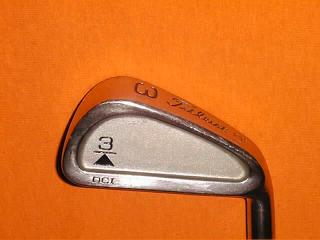
Review: SLDR Golf Irons
Note: This review was originally posted in June 2014. @saevel25 also reviewed the SLDRs.
@WUTiger 's review
TaylorMade SLDR Irons Review
June 21, 2014 By John P. Orr
Another TM club hits the market. Can the SLDR iron replace the R11 and hold its own in game-improvement land?
TaylorMade and parent company Adidas-AG have been in the news this spring, both for financial shortfalls and innovation. For finances, The Wall Street Journal reported on May 6 that Adidas had a 34% drop in first-quarter profits, which Adidas attributed in part to the sales downturn at TaylorMade.
For innovation, TM has put a steady stream of new club models on the market, including the SLDR family of a dozen driver models including the SLDR Mini Drivers – and assorted fairway woods. Also the Tour Preferred line of player’s irons has three flavors.
So, enter the SLDR irons. (In case you’re wondering, these irons contain no moving parts as do the SLDR drivers and fairway woods). The game-improvement SLDRs rank as successor to the popular R11 irons, falling between TM’s super game improvement Speedblades and player’s Tour Preferred trio of CB (cavity back); MC (muscle cavity); and MB (muscleback).
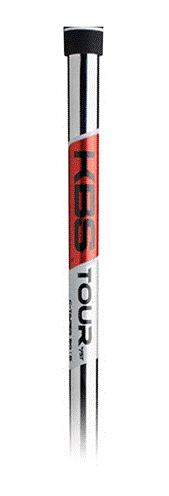
In the past, I played the TM Raylors, and had a season of RBZ fairway woods. For TM irons, however, this would be my first significant encounter. My current irons are game improvement X20 Tours - originally fitted with Project X - and recently reshafted with lighter NS Pro 8950 GH (regular). The NS Pros are in the same shaft band as the SLDR’s new KBS Tour C-Taper 90 shaft, which should set up some good comparison points.
The SLDRs have a sleek look, and sport a new C-Taper variant as the stock steel shaft. So, do the SLDR irons have what it takes to stand out in the TaylorMade club line, and game improvement land in general, or will these irons get lost in the product shuffle? Let’s see how they tested out for some clues.
Specifications
The SLDR model offers a 10-club arsenal, from 3 iron through SW. TaylorMade offers eight-club SLDR sets for $899, or $112 a club. I received the 4i – AW mix with a Regular shaft. Here are the overall specs:
Iron
Loft
Lie
Offset
Bounce
Length
SwingW
3
19°
60.5
4.9 mm
0.0
38.75”
D2
4
21°
61.0
4.4 mm
0.5
38.25”
D2
5
24°
61.5
3.9 mm
1.5
37.75”
D2
6
28°
62.0
3.4 mm
2.5
37.25”
D2
7
32°
62.5
3.0 mm
3.5
36.75”
D2
8
36°
63.0
2.6 mm
4.5
36.25”
D2
9
41°
63.5
2.3 mm
5.5
35.75”
D2
PW
46°
64.0
2.0 mm
7.0
35.50”
D2.5
AW
51°
64.0
1.6 mm
8.0
35.50”
D2.5
SW
56°
64.0
1.0 mm
8.0
35.25”
D4.5
Golfdom’s standard 3 iron measures at 39 inches long, and the SLDR shafts are a quarter-inch shorter than “average.”
Let's compare TM 7 irons : the SLDR has slightly more offset than the TP.CB (3.0 to 2.8 mm), but less bounce (3.5° to 4.5°). The SLDR’s lesser bounce may be compensated for by the extra camber - the rounded front-to-back arc on the sole – which would help the user-friendliness of the clubs.
Stock grips are the Golf Pride Tour Velvet. TM kindly fitted the irons with the Midsize grips I normally play. The Tour Velvets have a modest softness, and mesh with the glove hand well when I grip the club. The grips have a pleasingly solid, but not harsh, feel during the swing.
My set came with the stock steel shaft, the KBS Tour C-Taper 90 designed for TaylorMade. Stock graphite shafts include the SLDR by Fujukuri shafts, with 77 (X), the 67 (S) and the 57 (R) flexes. Custom steel shafts include other KBS at a $7 per club upcharge, three Project X for a $25 to $35 upcharge, three Dynamic Golf varieties and NS Pro 950 for $7 upcharges. Also, a Matrix Ozik 95-gram graphite is available.
The stepless C-Taper 90 blends the control of the C-Taper Lite with the higher launch of the KBS Tour 90. The table below shows the specs of these three taper-tip shafts:
KBS Tour Shaft
Flex
Weight (grams)
Trajectory
Torque
C-Taper Lite*
R
105
Mid-High
2.2
S
110
Mid
2.1
C-Taper 90 †
R
94
Mid
2.0
S
95
Mid
1.9
Tour 90*
R
95
High
2.5
S
102
Mid-High
2.3
* KBS website. // † TaylorMade Asian website
____________________
Note: Several weeks after writing this review, I got an e-mail from a TM tech rep concerning the C-Taper 90 shaft. He said the exact specifications were proprietary, but the shaft was similar in performance to the KBS Tour 90.
_____________________
Design and Technology
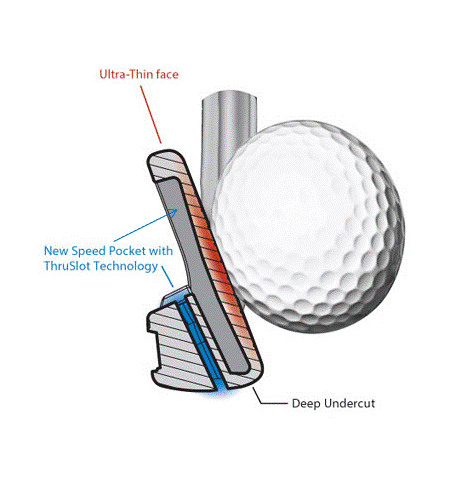
Like many in the game improvement category, these SLDRs offer a thin, flexing face and somewhat different design for longer irons compared to short irons. The thin face arrangement is backed by the Speed Pocket, pioneered in last year’s RocketBladez. The pocket, a hollow cavity that runs behind the clubface, allows the face to flex and deliver increased ball speed. This supersedes the Inverted Cone Technology used in the R11.
And, as with all TM iron models this year (except for MB), irons 3 through 7 have a polymer-filled ThruSlot that extends all the way through the back of the clubhead to the sole; it situates parallel to the Speed Pocket. This Thru-Slot promotes faster ball speed on the lower half of the clubface, where TaylorMade found 72% of golfers hit their shots.
SLDR irons 8 through SW omit the ThruSlot, which has diminishing benefits as lofts get higher. The Speed Pocket and ThruSlot also
function as part of the model’s vibration damping system, which helps with the club’s feel and sound.
The Speed Pocket and the ThruSlot, combined with the KBS Tour C-Taper 90 shaft, give the ball a very high launch. This high launch means the ball comes down steeply, helping it to stop on target. This is critical with irons fitted with low-spin shafts.
Designers produced a set which has loft differences of 3°, 4° and 5°, and half-inch shaft length increments through most of the set, until the 9 iron and wedges. Despite the unevenness, TaylorMade designers worked to tweak the faces and clubheads to ensure consistent distance differences up and down the set.
ThruSlot appears on irons 3 through 7 only.
Performance
I tested out the SLDRs at my golf club in a two-day trial. The first day I primarily hit them on the range, alternating with my current irons and comparing the two models. On full shots, the wedges were a bit short of my current ones, and short irons were about equal. In irons 4 through 7, however, the SLDRs started gaining yardage. The 4 iron was about a club longer than my current one.
The 4 iron pretty well matched my slightly longer-shafted 4 hybrid on distance, and on a couple of teed shots actually edged it with high, almost scary-straight shots. The hybrid was more reliable, but not as accurate. With the ensuing on-course performance, I would foresee this: If I’m playing twice a week, the 4 iron goes in the bag. If it’s twice a month, probably fall back to the hybrid.
For short game, the SLDRs showed well on chip and run shots. The ball came out low, checked once, and then released smoothly toward the hole. The 8 iron worked well if I had 25 feet or more to the cup; it came out hot, and was hard to control on shorter distances. The PW and AW, however, worked great for the shorter chips.
Also, SLDR has a solid approach wedge – gap wedge. I’m not normally a fan of stock iron set gap wedges, so the SLDR AW was a pleasant surprise. Gets the ball out of fluffy stuff well, and if opened up a degree pops almost like a lob wedge. The PW and AW gave me good line, but I’ll need to zero in the distances for partial wedge shots.
I had wanted to try the SLDR sand wedge at a local demo day. The SW only has 8 bounce, so I was curious about how it would perform. I couldn’t work it in, however, due to my volunteer shifts at the Curtis Cup, which the U.S. women amateurs won.
The next day I took the SLDRs out for a round. My tee shots were adventurous on several holes, so the SLDR irons got a varied workout. I hit the 8 iron into the par 3 No. 2, and for my approach on the following hole. Both shots landed pin high, but off the green to the left. On No. 3, I chipped with an 8 iron but ran it long, resulting in a bogie.
On No. 5, an uphill par 5, I hit a drive offline left into two-inch deep rough. I chose the 7 iron to try my escape, and hit a solid fade that stopped in the fairway at the top of the hill on one bounce. I then overclubbed on the approach, flew the green and ended up with a bogie.
The next hole, an elevated par 3 with a lake to the left, called for another 7 iron. I hit a shot long and left, which landed on the fringe and bounced into the lake. This being my third left miss, I did a check to see if my face alignment was perpendicular to the target line. When the club was square to the target line, it looked a degree open to me. So, I just need to retrain my eye and not slightly hood the club on set-up.
No. 9 saw the SLDRs shine. I pushed my drive into the medium rough, onto a ridge above a fairway bunker. With the ball above my feet, and 180 yards out, I expected a flier shot. But, the 5 iron went high and fairly straight, hit the false front of the green and spun back six feet into the fairway. From there, I had plenty of green to work with, and ran an 8 iron chip over a ridge and four feet below the hole. Sank the putt for a scrambling par.
The following hole I had an 8 iron into the wind, uphill from about 125 yards out. The shot hit the toe side, but carried up pin high into a greenside bunker. I came out of the bunker too strong, but picked an AW off the bank and rolled up 3 feet away, saving bogie.
The next was a short par 4 of about 300 yards. I teed off with a solid 4 iron draw, which left me 110 yards out. Since I was going into the wind, I hit a full PW. A nice high shot sailed 25 feet past the hole. Line was superb, but I was surprised I overcooked the shots going into a headwind.
A few holes later, I had laid up to 55 yards out on an uphill par 5. Laying three, I hit a half PW, normally 65 yards with my old clubs, but the ball bit about 15 feet short of the cup. I got an easy bogie, but could have been a par with better distance control.
No. 17 proved fruitful for the PW. I hit it into the short par 3, the ball landing 10 feet in front of pin and backing off the green. I then kept the PW and hit a short chip and run out of a swale, stopping it a foot to the left of the cup for a tap-in par. I just had to figure out when to chip with 8 iron vs. PW.
Overall, I had a pleasant first SLDR experience on course. It didn’t take long to get my basic setup – I like the low offset head design. And, the clubs will clear the ball out of the medium rough without having to muscle it – a benefit for those pursuing better swing tempo. Also, I actually overclubbed twice, a pleasant change of pace.
I especially like the 4 through 7 iron. Good distance, in part because rather strong lofts, but very reliable. As TM advertises, you don’t lose much distance if you hit it on the toe half of the clubface. It might not be on the green, but often will be pin high.
Esthetics
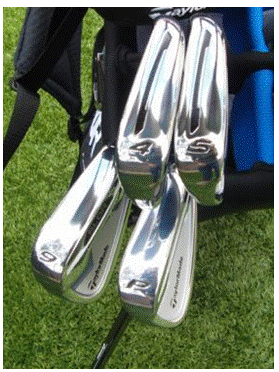
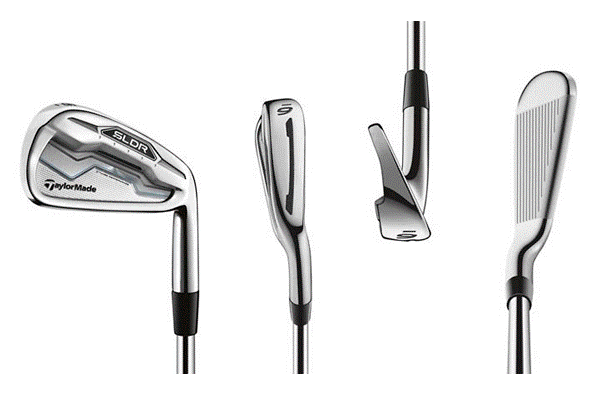
These irons have a distinctive look without glitz. Chrome head with satin clubface, black letter and number accents with a distinctive blue trim line on the back of the head, and black polymer inserts on sole and back of irons 3 through 7. A pleasant departure from the Halloween-orange trim that crept onto certain 2014 irons.
SLDR is kind of like a cross between a sports car and a fine scientific instrument. Some golfers will complain that chrome finish would keep them off the pro tour by reflecting too much sunlight into their eyes. I didnot find this a problem - the satiny clubface doesn’t reflect.
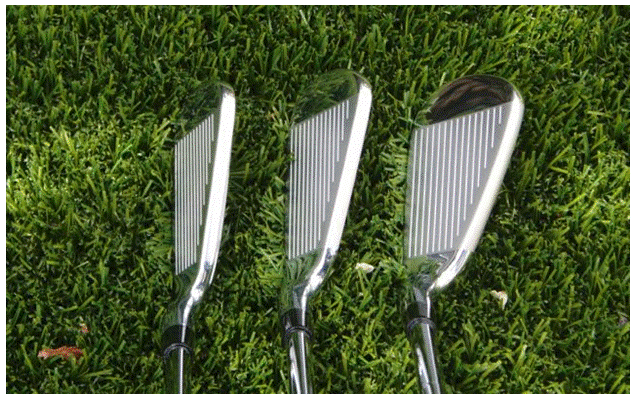
For golfers with topline angst, fear not! The topline is slightly narrower than comparable GI irons.
One attractive feature is the back of the clubs, which have a narrow rectangular tunnel slot rather than a deep cavern. This makes it less likely that grass and debris will get caught in the back of the clubhead after shots.
In addition, one feature which will protect the esthetics of the clubhead is the positioning of the Thru-Slot and polymers. These features are on the bottom half of the clubhead. So,if you need to fix a broken shaft, or decide to reshaft the SLDRs, you have less worry that the clubsmith will accidentally melt the polymers when heating the hosel to break the epoxy seal.
Conclusion
This club should appeal to a fairly wide range of golfers. I was able to hit quite a few decent shots on my first round with the SLDRs, and the club has enough forgiveness that players “on the cusp” of game improvement should try it. At the other end of golfdom, SLDR has one PGA Tour pro on board. D.A. Points put them in his bag on June 2, swapping out the custom Ping i5 irons he had played since 2010.
Reminds me of the Ping G15 from a couple of years back. A St. Louis golf pro told me he had fitted everyone from scratch golfers to 22 handicappers with the G15 – you just had to select the right shaft.
Basically, SLDRs fit what a competing company’s rep recommended for me: a game-improvement head with a lightweight shaft.
I will continue to play the SLDRs, and as I get used to them, recheck out the lie angle and shaft length. Any adjustments here could be made at regripping time.
The SLDR C-Taper 90 steel shaft is light, but not too light like the 85-gram steel shafts several companies inserted in irons starting in 2012. I proved wild with 85 gram shafts, and actually got a bit more distance with slightly heavier ones. A Golf Digest report explained the problem: average golfers can’t feel when they’re at the top with the 85s, and have trouble dropping them in the slot on the downswing. Low handicappers – most of whom don’t need the superlights - often get better results with 85s and such due to their their well grooved swings
What I like best about the SLDRs is the extra lift longer irons – 4 through 7 – with the ThruSlots. These play more reliably than most GI counterparts, and have less distance dispersion than my current irons. So, SLDR irons should serve the game improvement area well, and, with a variety of stock and custom shafts, likely attract golfers from other neighborhoods also. I expect SLDR to enhance the TM iron mix, and to hold its own against other company’s GI offerings.
-
 Latest Entry
Walked 18 holes. Shot 92.
Just walked 18. The pace was perfect. 4 hours to walk. I was worried I would hold people up, but my group was walking, and so were the people behind us. Really worked out well. Being able to walk is a total game changer. 5 mile walk makes it feel like less of a huge waste of time, LOL. I am of the old school of thought. Proper golfers don't use those silly toy carts. Carrying my bag for 18 started to get uncomfortable on my shoulder, and a bit clumsy, so I will invest in a push cart.
As for the round, it was a good one. I was driving straight most of the day. Possibly the best driver day of my life (I never hit driver during my 20s) I lined the driver up 2-3 inches behind the ball, to catch the ball on the upswing, and I finally got some loft on the drives. They don't go far, but many were straight. Had a few pure irons that felt great, but overall, I am hitting irons thin, and not really taking the right divot.
Shot of the day? I holed out a sand shot. Open stance, back foot, 2" of damp sand. One bounce and plop, into the hole.
Worst hole was +2, so that's good. I feel my misses are getting lucky. Thin iron still stays straight and in fairway. Only hit one trouble shot from under trees today.


Announcements
-
Member Statistics
-
Blog Statistics
-
Total Blogs33
-
Total Entries485
-
-
Blog Entries
-
-
Posts
-

-
.thumb.JPG.640dd6f31fe7f6aef91f879119bae1d9.JPG)
-
-

-

By dennyjones · Posted
There are plenty of great people here. Thanks for joining. I believe somebody will come along soon and comment. Welcome
-